Thursday, August 22, 2013

A Milestone Reached

Posting the Peck boundary.
An idea was born way back in 2011. It languished and was resurrected in early 2012. It was researched, talked about, plotted, posted, planned, obstructed, rearranged, fought for, and researched even more. At times it seemed the hurdles were too great to surmount. We wondered if the effort was worth it. But we were convinced it was.

Checking the boundary. 
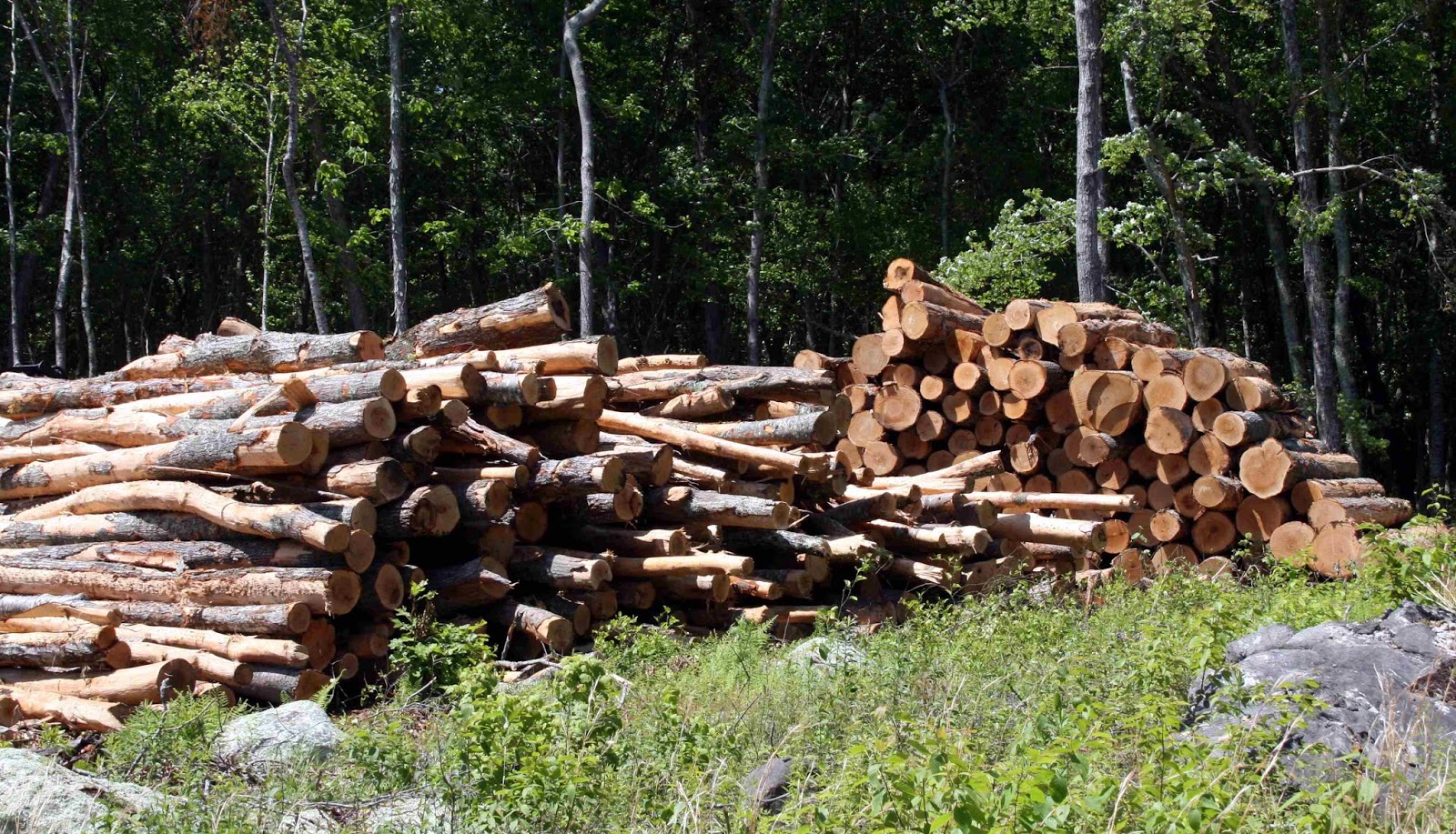
On May 23rd, 2013, we began the actual project-the creation of a New England Cottontail Habitat on the Peck and Callahan Preserves in Stonington. We've been writing about this project since the beginning with articles in our Avalonia Trails newsletter and an earlier blog post here. Judy Benson from the New London Day came to view the project and was impressed by its size and scope. We visited the site regularly and watched trees cut with precision, guided to earth, stripped of limbs, measured, and cut, all by an amazing Harvester machine. Huge piles of logs were stacked and hauled out to offset the cost of the project. We left piles of cord wood for our neighbors who gave us passage to bring our machines through their land.
The Harvester machine at work.
Some of the cut trees from the Peck Preserve. 
At long last, the contractor, Ted D’Onofrio of TRLandworks took his last piece of equipment off the site on August 6th. 
The last machine out.
What remains isn't pretty at first glance. The long swath of the Peck Preserve, is open now. From a distance, it is pretty brown, a little disconcerting to a self-described tree hugger but we looked closer.
The machines used were designed to have a low impact on the earth so we do not have any large areas of torn up ground. The wetlands were respected and left buffered and the stream now runs clear and clean.
Specially chosen trees remained standing to provide reseeding sources, mast for wildlife, and some shelter. A nice diversity of species is still present. Understory shrubs lie unharmed in most areas. Blueberry and huckleberry plants, as well as smaller seedlings, ground covering vines, and small plants, will thrive in the open canopy.
A few selected trees still stand.
Referred to as slash, those tree tops and branches left on the ground provide instant cover for small mammals. The rough slash will also deter deer that will try to enter the new area of inviting shoots and greenery. The decomposition over time will provide nutrients for the soil. As part of the funding agreement, large brush piles were created. These will provide longer term shelter for many animals, and hopefully the New England Cottontail will be one of them!
Site of a future New England Cottontail housing development.
As we walked the entire site, we noticed new birds already. Several types of Flycatchers: Peewees, Phoebes, and Kingbirds, were having a field day with the numerous dragonflies cruising around. Several butterflies made use of the now-open areas: Red-Spotted Purples, Black Swallow tails, and American Coppers. We could see that the ferns, low plants, berry bushes and vines such as greenbrier were already beginning to grow up and fill in. On close inspection, it was wonderful to see the tree stumps already re-sprouting vigorous new shoots. Oaks, Beeches, Maples, Birches and Hickories all seem to be in a hurry to get a jump start on re-growing. It is this new growth that will provide the food and thick, dense cover that we aim for.
New growth at Peck.
We still have work to do. There are more piles to build. We need to seed some open slopes to create quick cover of exposed soil, and we will plant native shrubs not already present on the property to add new diversity to the flora. We need to be vigilant to keep out and eradicate invasive plants that will be opportunistic and try to establish in the new open site.
And this winter, when there is snow on the ground, we will go out hunting for little brown pellets signs that maybe the New England Cottontails have indeed moved in.

Written and photographed by Beth Sullivan.

Thursday, August 15, 2013

Wandering Far A-field

Everyone can identify it, by what-ever name you choose to call it: Field, Meadow, Pasture, Lea, Grassland.
We all know a field can be cultivated: for corn, varied other crops, even Sunflowers for wishes. Local farms keep many acres as grass land, sweeping and green, to be cut several times a season for hay that they will bale for their livestock. All of these kinds of fields certainly have their uses and support some wildlife, even if it is the deer and raccoons and birds that feast within them. But none of these support the variations in plant and wild life that a natural field will.


Sunflowers on Buttonwood Farm.

Hay, cut and drying, waiting for baling. 

Avalonia has quite a number of preserves that are comprised in some large or small part of open fields. 
Newly mown field at Knox Preserve.

Contrary to what it might seem, fields often require the greatest effort and planning for management.
Some fields are maintained as grasslands. Large expanses where the main plants are true grasses of many kinds provide a unique habitat. There are several species of birds that are of great concern in CT because of the disappearance of large open grass fields. Meadow Larks and Bobolinks are two that can nest here and require over 20 acres of open space, large fields for their nest sites, near or on the ground, deeply surrounded by grass. Visit the Wequetequock Cove Preserve on Palmer Neck Road in Stonington. If you pull over at the edge and peer through the break in the hedgerow you will note that the field there remains tall and uncut for the entire summer. This is to encourage and support the Bobolinks that nest there. Many farm fields attract these birds, but they are often mowed several times each season, and this is destructive and often fatal for the nesting birds. These fields here are only mowed late in the summer or early fall when nesting is complete, and the grass is left on the ground there to provide nutrients for the soil, seeds and cover for small mammals and insects. There is a path around part of the perimeter of these fields to allow you a better view, but walking through these fields during nesting season is not permitted.
Bobolink in Wequetequock field.

Fields are not static; they evolve quickly season by season. Grasses give way to other herbaceous plants, annuals, biennials and perennials. Milkweed is an early addition as wind borne seeds float in. While most animals will not graze on Milkweed, the Monarchs require it as a host plant for depositing their eggs and for their caterpillars.(7) Goldenrods quickly colonize the open sunny areas and attract all sorts of pollinators: bees, butterflies and birds. 
Monarch caterpillar on milkweed.

 Biennial Queen Anne’s Lace, while non-native, is a naturalized member of the carrot family and hosts many species of insects, including Black Swallowtail butterflies. Asters, Iron Weed, Black Eyed Susans, and Joe-Pye Weed all gradually find their way into a field and provide beauty for us to enjoy and offer varied food and nectar sources for insects. Birds soon follow to consume these insects as well as find vital seed sources from the grasses and flowers. There are abundant grazing opportunities for mammals ranging from woodchucks and rabbits to deer. Rodents collect seeds and create burrows and tunnels. Coyotes and foxes and birds of prey follow the small mammals. Visit the Knox Preserve for an example of fields in evolution. Witness the wealth of wildlife present there.
Native Asters
A male Goldfinch surveys his field.
Wild flowers fill the field at Knox Preserve.

Even these fields require management. Mowing is necessary at least every other year to prevent woody stems from accumulating and tougher shrubs from growing in and taking space and creating shade. Non-native invasive weeds and vines threaten to over-run a meadow and need to be cut back. Constant vigilance is necessary to remove them from the fields before they can totally over take the natives. It takes stewardship planning, effort and money to maintain even the most natural looking meadow. Avalonia thanks its many volunteers for their efforts to do so.
The field at Wequetequock Cove Preserve.

Written by Beth Sullivan

Photography by Beth Sullivan and Rick Newton.

Tuesday, August 6, 2013

Girl Scouts clear trails to earn Silver Award

All our hard work has paid off! My fellow troop member Natalie Schafer and I, Heather Smith, wanted to earn our Silver Award together, the highest ranking award for a Cadette girl scout. Our troop leader, Mary Schafer, met Joellen Anderson, the chair of the Groton town committee of Avalonia Land Conservancy, at a Girl Scout event. Joellen thought it would be a great idea to clear trails, and get more people to use the trail at ALC's Moore Woodlands Preserve in Groton as our Silver Award project. Natalie and I, of course, said yes to the idea and started as soon as we could.
Girl Scouts on the Moore Woodlands.
We started in November of 2012. First, we found a trail that needed to be cleared and Joellen gave us permission to name the trail. We thought of calling it Mother Nature’s Highway because the trail ends at Route 215. Throughout the fall, we cleared and blazed Mother Nature’s Highway. The blazing was a fun experience for us because we had no idea how to blaze or what the blazes mean, but Joellen taught us how to, and what they mean, and we successfully blazed the trail.
In the spring, we started clearing the trail again. We couldn’t do anything outdoors during the winter because there was so much snow on the ground. However, we did make an “I Spy” hunt for the children that use the trail. We also typed up a flyer to advertise that we were working on the trail. Finally, we created letterboxes for our trail. The theme of the letterbox series was trees. After the messy winter was over we went straight to work. We made bee boxes for the Mason bees in the Moore Woodlands. Then, Joellen told us there was another trail that needed clearing and blazing. The trail was called Town’s End. After we cleared and blazed, we thought of an idea to install bridges in at the end of Mother Nature’s Highway because there was a little stream that you had to jump over to get across. First, we need to see if we needed a permit to be able to install the bridges. We presented our ideas in front of the Town of Groton Inland Wetland Agency, and they determined that we didn’t need a permit to install the bridges. After that we built the bridges, and installed them on the property.
In the end, we needed only a few more hours to complete our Silver badge requirements. Natalie and Joellen thought of holding a big hike after we finished to show how hard we worked and all of the progress we made. We held the hike and showed the trail. Then Joellen told us about a six mile hike that ended at Avalonia’s Town’s End. We served fruit, cookies, and water to all of the exhausted hikers. After we served the snacks to the hikers we had completed our fifty hours of work! And finally, on June 5th, 2013 Natalie and I earned our Silver Awards. I guess all the hard work did pay off!!

Written by Heather Smith.
Learn more about the Moore Woodlands.

Thursday, August 1, 2013

The Land Conservation Process: From Acquisition to Stewardship

Avalonia Land Conservancy is excited to host an educational and informational event at 5:00 pm on Sunday, September 29 at the La Grua Center in Stonington, CT entitled "The Land Conservation Process: From Acquisition to Stewardship". Attached is a save-the-date card that highlights the date, time and place. Additionally we will be sending out an invitation with more details in early September.


Wine, non-alcoholic beverages and light appetizers will be served after the presentation. This event is free and open to the public, so please mark this on your calendar and invite a friend to join you and/or meet some new friends at this event. Space is limited so kindly RSVP by September 20th to 860.884.3500 or avalonialc@yahoo.com


Thursday, July 25, 2013

Continuing the Mission

Avalonia Land Conservancy’s mission statement reads: “…Preserving natural habitats in southeastern Connecticut by acquiring and protecting lands and by communicating the value of these irreplaceable resources”.
In order to better understand and communicate the value of our resources, Avalonia promotes educational efforts on our preserves. By welcoming students and supporting their projects we benefit from their knowledge and insight as well as make valuable connections to the extended resources they represent.
Here in Stonington we have a widely varied offering of habitats and preserves. Over the last several years we have made some wonderful academic and scientific connections and offered numerous opportunities for study. We have had students as young as preschool, and all the way through college and graduate school, working on projects on Avalonia properties.
In 2011-12 a student from Brown University studied the presence and effects of Sesarma (Marsh Crab) on the Cottrell Preserve. These crabs burrow in the mud along salt marsh edges, consume the grasses that support the edges, and seriously erode the marsh when their populations are large. 
Holes used by Sesarma Marsh crabs can cause erosion.
For several years, including 2013, University of Connecticut students have visited several marshes in town, including the Woolworth Preserve and Paffard Marsh this year, to study the birds that make use of the different habitats associated with these areas. Arriving at dawn, the different teams looked for the uncommon Seaside Sparrows and Salt Marsh Sparrows as well as other marsh nesters. Other teams surveyed the areas where the woodlands met the marsh for birds that use these areas. 
Yellow Warbler is one of many species that use marsh edges.
On the Peck and Callahan Preserves, the USFWS and DEEP, along with Avalonia volunteers, will begin a long term study of the wildlife that makes use of the newly created shrub and young forest habitats. We will especially be looking for the New England Cottontail and several shrub dependent birds like the Brown Thrasher and Yellow Breasted Chat.
The Knox Preserve has been the focus of many studies over the years. For two decades, Federal Bird Banding has been conducted on the preserve and meticulous records kept of observations and populations and species. This year, with the successful establishment of a Purple Martin colony, the DEEP conducted a special banding operation to add to the data being collected about this species, their migrations, returns and dispersals throughout the area. 
Robin being processed prior to banding.
Purple Martins at the Knox Preserve are now part of a migration and dispersal study.  
Connecticut College students from the Goodwin Neiring Centerfor Environmental Studies, conducted numerous projects this past year. They included studying the drainage and plant life of the brackish pond there. Another group studied the field restoration effort and introduced native plants; others enhanced the bird housing availability on the property.
Sandy Point, our Island just off Stonington Point, has long been studied. The bird populations are documented frequently during the nesting season with special attention to Piping Plovers, Least terns and American Oystercatchers. Horseshoe crabs are tagged and counted as part of an ongoing study, Project Limulus, conducted by Sacred Heart University. The island is well renowned for its population and nesting habitats for these ancient and valuable animals. 
Project Limulus studies the Horseshoe Crabs at Sandy Point.
Dodge Paddock, which has been the subject of efforts by Avalonia and DEEP to improve the habitat by improving drainage and removal of the invasive Phragmites, will also now get its own study group. A doctoral fellow and team from Trinity College will be monitoring the Phragmites removal efforts, and will concentrate on regeneration of native plant diversity in the areas where the Phragmites have been eradicated and the effect the treatment has on the soils in the area. 
A new team will study the long term treatment of 
Phragmites that have taken over Dodge Paddock.

Every time we encourage a study effort, we benefit from the knowledge they have gained and in turn are better able to steward the lands entrusted to our care.
Written by Beth Sullivan. Photography by Beth Sullivan and Rick Newton.
Learn more about the preserves mentioned here at avalonialandconservancy.org.