Monday, February 3, 2014

Should we migrate this winter??

By Beth Sullivan
Isn't it just mind boggling to think that creatures as fragile and beautiful as birds, can survive such winter weather as we have been experiencing?
They not only survive, but many seem to relish the cold and snow. Nature has endowed them with numerous adaptations, physical and behavioral, that ensure that most will indeed make it through the winter.
You don’t have to go far to make observations. As lovely as a walk might be, out and about on a beautiful trail, you can learn plenty about birds from the comfort of your warm home.
Simply: if a bird can find food, it will remain here and survive the winter. With super high metabolisms, birds need constant fuel. They will search out the highest caloric foods. Nuts and seeds are high in fat and protein but often the effort to find and crack seeds seems to be greater than the value of the food. Watch a Chickadee fly back and forth to your feeder. Each time it grabs a seed, it must fly away to a hard surface, grab the seed between its feet and chip away at it until it opens. They seem to be in nonstop motion throughout the day.
Chickadee working to open a seed.
You may notice that there are still berries on a number of species of shrubs. The cold temperatures preserve them, even ferment them, making them quite warming to those birds who seek them out, like Robins, Bluebirds and Cedar Waxwings.
Most insect eaters will have flown south, but some Woodpeckers and Nuthatches know how to find insects, eggs and larvae hidden under bits of bark on tree trunks and branches.
Downy Woodpecker rests on the lee side of a branch.
Suet provides high fat, protein, seeds and even berries and will be visited by many birds in winter, even those usually not associated with suet feeding. With good food sources, birds will pack on the grams of extra fat to keep them warm and get them through the long nights.
Bluebirds enjoying a suet snack.

Grackle eating suet
Feathers: hard to believe those delicate feathers can provide enough protection to keep those little bodies warm. Birds actually will add a layer of down during the winter months. It doesn’t change their appearance. Watch a bird sitting on a branch and you might notice him fluff up a bit. By doing this, he can trap more warm air around himself. Think of us using several light layers instead of one heavy one, for most warmth.
White Throated Sparrow fluffs up to insulate himself.
Observe a bird on a tree trunk. In the wind and cold they will find the lee side or the sunny side to just rest and save energy. Birds do shiver. They contact their muscles, alternating groups, and create warmth from the action. That is really hard to see under all those feathers!
Brown Creeper looks for food under bark and lichen.
Cold Feet? Ever wonder how water birds, as ducks and geese and gulls can stand on ice and not suffer the consequences? The circulation in their feet and legs is quite unique, preventing truly cold blood from returning to the core, but warming it on the way! Watch as small birds in the snow or gulls and others on the ice, will stand on one leg and curl the other up into their breast feathers for warmth. That helps too.
Ring Billed Gull with one leg warming
So take a walk and search out the birds enjoying the winter. Or better still, find a window, get out your binoculars, learn your feeder birds and notice the small things that help them survive. It will help you with our challenge next week!

Photographed by Beth Sullivan. 

Monday, January 27, 2014

Planning the future of the Barrett Preserve in Ledyard

By Mike Goodwin
Each of our member Town Committees is tasked with preparing property management plans for the preserves in their town. This is a time consuming task and Avalonia has a long way to go to finalize plans for all our properties. In Ledyard much work has been done to develop these plans and to implement the work recommended. One of the major properties receiving a lot of attention is the Barrett Preserve.

The Barrett Preserve was transferred from the Nature Conservancy to Avalonia Land Conservancy in 1994 and has been a nature preserve since 1967. Avalonia maintains hiking trails on the property and has maintained an open field and dogwood grove at the entrance per the previous owner’s request.

In preparation for writing a property management plan, Avalonia secured a grant in June 2011 to prepare a forest stewardship plan from the Natural Resource Conservation Service, NRCS, a part of the US Department of Agriculture. Connwood Foresters, Inc. was hired and delivered the forest stewardship plan in March 2012. The Property Management Plan for the Barrett Preserve was completed shortly after receiving this plan.
The forest stewardship plan recommended six one-acre canopy openings to encourage young tree growth to improve forest age diversity and an additional three one acre cuts to remove the abundant black birch from the old burn area to encourage a more diverse forest. The plan also recommended girdling three trees/acre and construction of one brush pile/acre for small animal shelter. Girdling involves removing a band of bark and cambium around a tree’s circumference to kill it and leave a standing snag. The Barrett Property Management Plan changed this recommendation to clearing three one-acre cuts plus one three-acre cut in the burn area. We did this because of wetlands and access limitations to portions of the preserve. The plan also included clearing invasive plants from under the dogwood grove and continued mowing of the field in the fall.
These young Birch trees are a monoculture which is detrimental to the forest 
The Barrett Preserve, like most of the forested lands in Connecticut today, is covered by a forest of uniform age with little young growth. The soil is very rocky and wet over large portions of the preserve. In a major storm we expect significant wind damage which would take many years to regenerate without some young trees in the mix. Storms over the last two years have emphasized this problem with large trees being uprooted in the wetter areas.
Slash left on the ground will encourage fungus growth which will aid decomposition.
Avalonia applied for and received a grant from NRCS in February 2013 to implement the planned work. In summer 2013, Connwood Foresters, Inc. was hired to mark the trees to be cut. The area was surveyed and trees marked in early November 2013.
Avalonia plans to contract with a logger to complete the tree removal on the three one-acre tracts in early 2014. We plan to clear the three-acre burn area of small black birch over the next year using volunteers. We will leave the downed trees on site to discourage deer from eating the expected new growth. There will be some unsightly areas on the preserve for a few years but there should be a lot of new growth and enhanced wildlife habitat in the near future and for years to come.
The Mountain Laurel understory will benefit from more light.

Photographs by Beth Sullivan.

Monday, January 20, 2014

Where does the Fox go?

By Beth Sullivan
We all have been through some pretty brutally cold weather recently and some pretty erratic temperature swings. Can you imagine what a toll it takes on our resident wildlife?
Take a winter walk and, if you are really lucky, find a child to take with you. Think like an animal in winter.
Any nature preserve or bit of woodland or backyard will work, but try Paffard Woods off North Main Street in Stonington.
We tend to think of mammals in winter as hibernators, but in reality most of them are not. Locally the Woodchuck or Groundhog is our deepest sleeper. In the late fall they fatten up and retreat into deep burrows, far below the cold surface. Their metabolism slows, and they will not emerge until February or March. Woodchucks can be found in woodlands, but more usually along farm fields and open lands, their burrows marked by mounds of earth.

Red Fox
Most of our other resident mammals are only semi-hibernators. They may be inactive for long periods of extreme cold and bad weather, but will rouse themselves and move about during the winter months.
The Red Fox will adopt a Woodchuck burrow in a more open area and preferably near water. They pair up in winter and dig or expand a den as part of the bonding process. You may come upon a woodchuck hole with what appears to be a lot of new gravel at the entrance. At this time of year, Woodchucks are sleeping. It is the Red Fox doing the digging. You can often sniff out a fox den too; they have an odor similar to skunk which lingers near their abode. They hunt mice and small rodents and have an uncanny ability to find them deep beneath snow. Have that child you are with look for mice tunnels, look for foot prints in the snow, and look for holes that look active and smell skunky. That’s where the Fox goes!
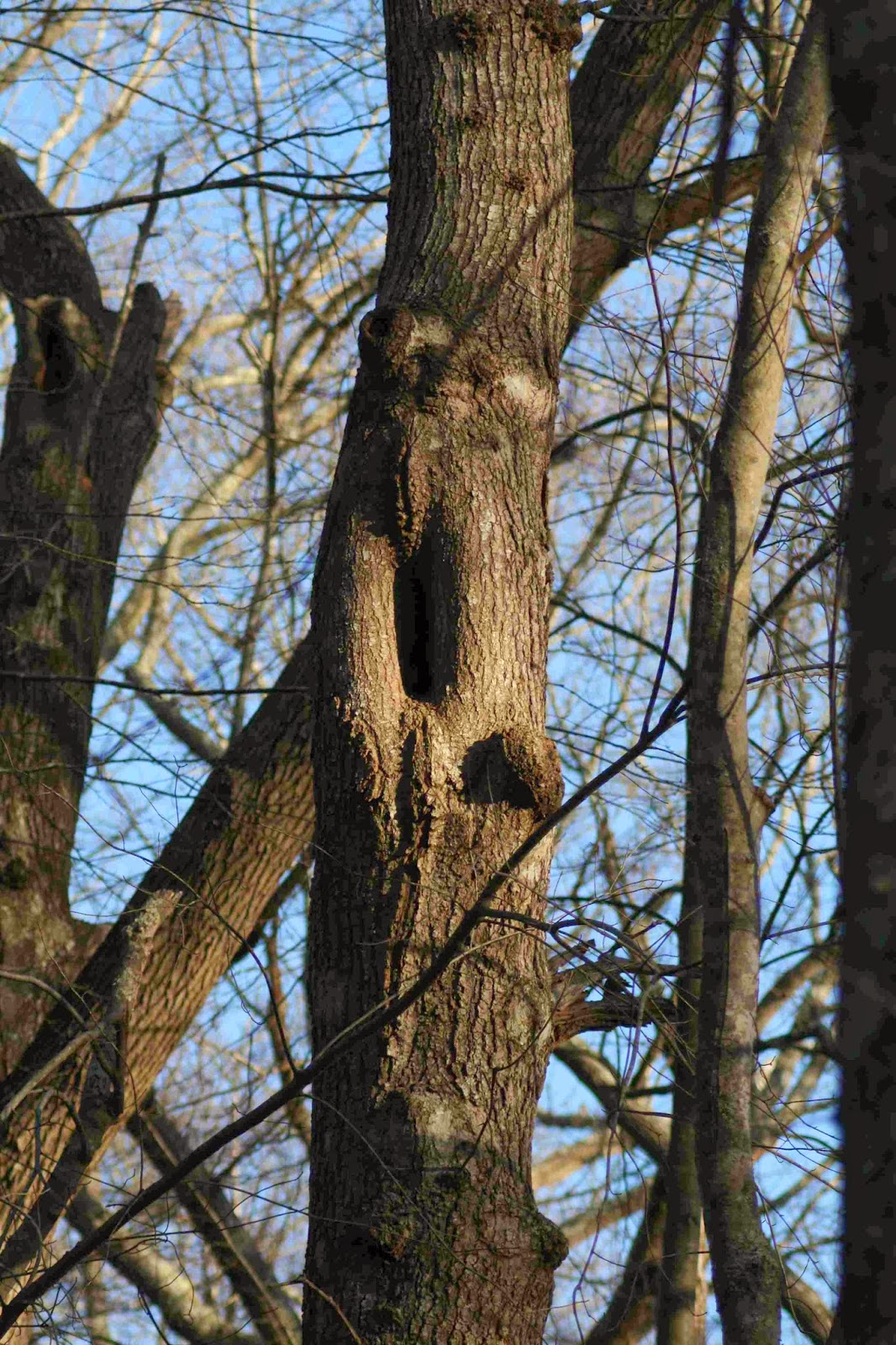
In the woods, look up and down for holes: holes up in trees, at the base of trees, in crevices, under rocks and by stone walls. Little ones and big ones. Just imagine what might be in them.
Large hollows in trees are good for many mammals.
The Gray Fox is our true native fox, and they tend to like the rocky woods. Look for holes at the bases of the ledges and between boulders. With the brook nearby, that would be a perfect place for a den.
The Gray Fox likes a rocky den.
Opossums and Skunks are usually considered nocturnal, but during the winter they make use of the warmth of daytime to forage. They will hole up in a tree cavity or hollow log, often in family groups. It’s warmer that way.

Gray Squirrel.
Holes at the base of trees often lead to tunnels higher up in the core of the tree. Hollowed out by ants, smaller creatures, like Chipmunks, will stash their nuts and seeds and remain sheltered inside. Squirrels will make use of holes, but also make big fluffy, leafy nests high in the branches and may rotate their lodgings as the mood strikes them.
A Squirrel's leafy nest.

Chipmunks will nest in stone walls.
Hickory nut shells at the base of this tree hint that someone is inside.
Raccoons will be active irregularly during the winter. When it is truly cold and stormy, they will seek refuge usually high in a tree, a hollow or snag. You might even find a raccoon peering out at you from a high safe place as you take a winter walk, but you have to be looking!
Small holes for squirrels and even some birds are found high up in trees.
Get that child to stop and look, all around. Find the holes high up and low down. Look in the ledges, wall, trees and stumps. Think like an animal and see where he or she might choose to spend a cold winter day.

Photographs by Rick Newton and Beth Sullivan.

Monday, January 13, 2014

Don't forget The Dog Watch Cafe Fundraiser this Wednesday


Remember The Dog Watch CafĂ© in Stonington will host a fundraiser to benefit Avalonia Land Conservancy on Wednesday January 15th 2014, during the restaurant’s regular opening hours of 11.30am to 9pm.  Customers can order the lunch or dinner from the Dog Watch’s extensive regular menu (www.dogwatchcafe.com), and if they tell the waitstaff they are there in support of Avalonia, the generous proprietors will donate 15% of the check to Avalonia, no coupons needed.
Avalonia Board members will be present to during the day to meet interested customers, to answer any questions about Babcock Ridge and to discuss Avalonia's mission of conservation in southeastern CT.

A Good Steward

By Beth Sullivan
Sometimes people make special connections to a certain piece of land. Maybe they live near by, maybe it is a favorite place to hike, maybe there is a historical tie to the property. Something draws them to a place, and they choose to devote time and effort and offer TLC to a favorite preserve.
The trail head
Our friend RB is one of those people. His family has ties, very close ones indeed, to the White Cedar Swamp and Deans Mill Preserves, accessed off Jerry Brown Rd. in Mystic. RB grew up on these lands as years ago his family owned a large farm, most of which is north of I-95. The Deans Mill Preserve is that portion of his childhood farmland that was cut off from the rest and is south of the interstate.
RB has taken us through those preserves and lovingly pointed out the historic features, walls, bar-ways, old roads, areas where trees were harvested and a lovely fresh spring. The area boasts ledges, bald rock faces underfoot, and some spectacular peeks over the Deans Mill/Aquarion Reservoir.
A stone bench waits for winter hikers.
One of the unique features of the area, is a rare, White Cedar swamp. Atlantic White Cedars grow in wet, acidic boggy areas. The plant community is quite rare this far south in CT. Over the last years RB noticed that the area was changing. The cedars were dying out; there were no new seedlings coming along to replace the old ones, and the entire ecosystem was evolving. Red Maple and Black Birch trees were growing into the sunny openings. They are rapid growers and quickly invaded and crowded the Cedars which cannot compete.
The boggy pond is frozen over.
Preservation and conservation are interesting concepts. They don’t always mean just letting nature take her course. Stewardship is where Avalonia makes decisions about the best way to manage and help preserve special habitats. Knowing that we would certainly lose the central gem of this preserve without some action, RB engaged on a personal mission to save the White Cedar Swamp. Over the last several years he has begun to cut down many of the smaller sapling Maples and Black Birch. He has also thinned out many of the larger ones to reopen the area to the sun that the Cedars need to thrive. Some of the larger trees have been girdled- a process that cuts around the tree into the bark. It ultimately will kill the tree but the tree remains standing as a snag, roost site and habitat for insects and birds.
Mature White Cedars
RB also transplanted seedling White Cedars from elsewhere in the preserve, back into the areas that were lacking, thus giving Mother Nature a jump start on the restoration of the swamp population.
A White Cedar seedling

Nature takes her time. Having a steward like RB gives her a boost and a gentle nudge in the direction we hope will be the most valuable for wildlife and overall habitat.
Small cones and scales of green mark a White Cedar in place of needles and large cones of other conifers.
A recent walk on a winter’s day gave us lovely looks of the swamp, the rock faces of ledge and trail which was slick with ice but with moss and lichen still visible. The stone bench overlooking the pond was covered with snow. We noted seedling cedars standing up bravely in the cold. With the opened up canopy and more sunlight, they will certainly grow quickly and continue the line of White Cedars in the Swamp.

Photographs by Beth Sullivan.