Monday, February 8, 2016

Getting our house in order

By Beth Sullivan
Not everything a Land Conservancy does has to do with hands-on tree hugging! Though most of us wish it was!
We have so many places to share.

On the face of things Avalonia is about Land Conservancy, it’s our name. Our mission statement reads: “ We preserve natural habitats in southeastern CT by acquiring and protecting lands, and communicating the value of these irreplaceable resources.”
We acquire, we protect, we steward and manage, and educate. Yes, we even hug the trees.
We dedicate our special acquisitions.

However, as with many other types of organizations, there are standards to be upheld and practices to be followed. And, in order to determine compliance, there is always “A TEST.”
The Land Trust Alliance (LTA) is the over-seeing organization that has put forth the Standards and Practices rule book. A huge collection of everything you could need, or want to know, and more. In order to become accredited with the LTA there is a daunting process that Avalonia has embarked on: making the commitment to adopt the polices, uphold the high standards and follow the practices that are recommended. This means at every step of the way.

Everything is scrutinized 

A lot of what goes on behind the scenes of a full-functioning land trust is paper shuffling, as much as we all hate to admit it. It is essential to being able to carry out the mission. The LTA is scrutinizing every thing we do from paperwork to posting signs and pruning vines!
We educate others about our special places.

Governance and Development happen behind the scenes. How the organization is structured and run and operates will be reviewed. All the things we as volunteers take for granted, like the rules and guidelines we seem to follow instinctively, must be spelled out and documented.
Strategic Planning is more than just a dream of where we want to see ourselves as an organization down the line, but an actual concrete statement of how we plan to get there, and stay there, in perpetuity. This land protection stuff is not for the short term.
We inspire the curious.

Of course there are Finances. No one likes to think about money. Everyone wants to play in the woods. Everyone wants their donations to go directly into the land and acquisition, but what most don’t know is that even raising quantities of money for stewardship and acquisition, takes money. Managing, organizing, and accounting for a land trust’s finances, takes special skills. Fundraising is another set of skills.
We need to reach out to our members, but that is preaching to a very wonderful choir. We are working to reach beyond our members, to convince others who use our trails, see our signs and love the land, to join us with their membership and donations. The open space we protect benefits the entire community.
Reaching out takes skill and time. Designs, graphics, data bases, mailings news blasts, social media management. (Can you help with these?)
Land doesn’t come freely anymore. Or at least not very often. Quality habitat comes with a hefty price tag, especially if it is deemed quality habitat for people as well. Our Acquisition team is on a solid base with volunteers who know how to get out to find the land, connect with the landowners, and reach out to find the funds. LTA will evaluate how we set up to Acquire land.
We care for each property as the donor would  wish we did.

Then there is Stewardship

The heart of the matter. Right now Avalonia protects about 3500 acres of land. I am not sure anyone has actually tallied the miles of boundaries that need to be surveyed at acquisition, posted with signs and walked annually. There's also maintenance, mowing, trail creation and upkeep, invasive species management, building bridges, and installing signage to perform. And, of course, Management Plans to write!
We develop management plans.

In order to get our Stewardship house in order, we are indeed checking boundaries, looking for proper posting, and documenting any encroachments. This is all good. Our management plans are done.

We make sure we know our boundaries.

And, we make sure others know our boundaries.

Check out our website for more information about the Land Trust Alliance, Standards and Practices to get a glimpse of what we, as a volunteer organization, your regional Land Trust, are striving for.
Cramming for an exam makes us really get to the details. We are learning a lot. But we still have time to get out and hug the trees!
We always have time to hug a tree.

You can find more about the Land Trust Alliance here.
To learn about the Standards and Practices of the LTA, look here.
Photographs by Avalonia volunteers.

Monday, February 1, 2016

In between winter and spring

By Beth Sullivan
Supposedly we are in the middle of winter. The mid-portion of January often boasts the coldest temperatures of the year. We have had some cold, for sure, and our big snowstorm last week, but already the grass is showing again and the last days have been warm. The Blizzard is a memory.
A little winter doesn't deter most of us from enjoying the trails in White Cedar Preserve.

A walk in the woods last week was quite a surprise. The wetlands were not frozen. Standing water filled holes among rocks and hummocks of moss. Spikes of Skunk cabbage broke through patches of snow . Fringes of ice-rimmed pools had swirls of bright green watercress breaking the surface.
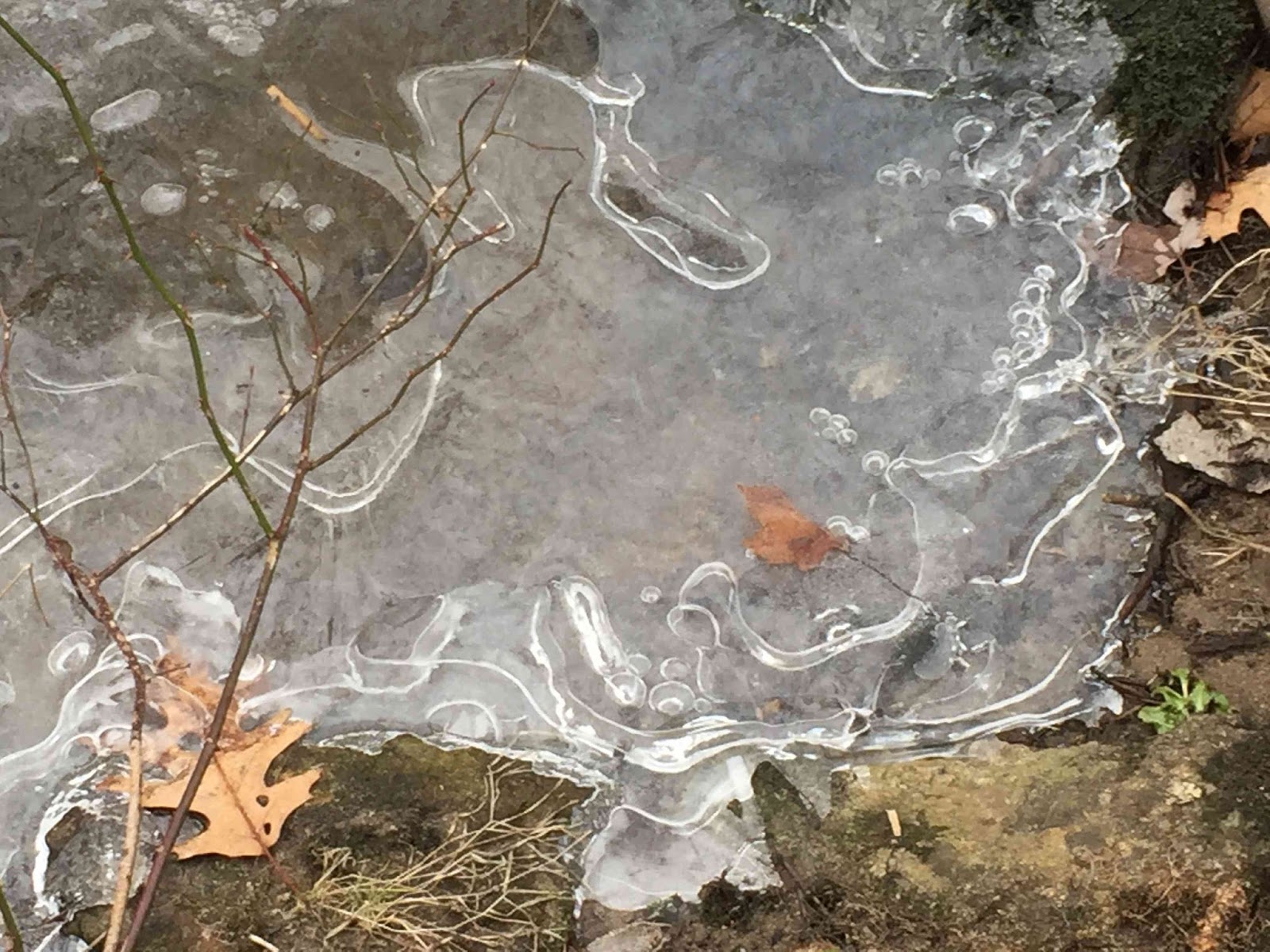
In Fennerswood Preserve, delicate patterns appear in the melting ice.

The first spikes of Skunk Cabbage have broken through the snow at Parker Brothers Preserve.

A Cardinal sang its spring song while White Throated Sparrows rustled in the underbrush.

Bits of winter, bits of spring

I don’t believe in letting one’s guard down. Winer can still turn around and wallop us. But why not appreciate the little tease we are experiencing. What we discover this week during the thaw time, might be just enough to tide us over during the next storm or deep freeze. Each day we advance means winter loosens its hold a bit more and the effect of a storm melt away faster.
Let's hope the Groundhog doesn't see its shadow at Knox Preserve.

Pussywillows are already in bud and don't seem to mind the snow.

At Paffard Woods, someone just had a mid-hibernation snack.

So here is a quick challenge. Take some time this week to find those bits. Notice the contrast between winter and spring. Find the green in the snow. The soft in the hard. The melt in the freeze. The bird song in the winter stillness.
Sphagum moss in the wetlands is already soft and green.

Appreciate every little bit we get, because it gets us closer to the day when winter will let go and spring will win out and take over!
At Stony Brook Preserve,  the snow has melted on a sunny rock face, but icicles still hang on.

Without the snow cover at Knox Preserve, the rodent tunnels are easy to spot.


Photographs by Beth Sullivan.

Monday, January 25, 2016

A Change of View

By Beth Sullivan
Amazing what a fresh snow cover does to our perception of the landscape. The uniform tones of brown and gray on the woodland floor have been covered. The new background allows everything else to stand out more sharply.
Delicate shadows would be overlooked in other seasons.

Fallen logs are now more dimensional with their layer of white, softening the top and creating horizontal intersections amid the upright trunks. Trees of varied species seem to exaggerate their differences now. It is easier to see the texture of bark: smooth slate colored Beech, ripples and ragged edges of Yellow Birch, the rugged cross hatch of Sassafras , Ash and Oak, the long loose “shags” on the Hickory. Each of these designs repeated over and over in the woodlots . The pattern of branching limbs seems easier to note now, easier to spy the lone leaf still holding on, fluttering beige against the backdrop of white. Nature study in winter is dependent on more subtle things now with no flowers and leaves to aid identification.
Time to look more closely at bark.

Snow: not what you think

The purity of whiteness is reflective of light and brightness now. To many it is just white. But take time, look harder, note the blues and lavenders of shadows. Shades of gray. Look for golden sparkles and diamonds . Textures and designs. The white of new snow is never just white. It is never just snow.
There's a lot of color in a white landscape.

The sharp sunlight and extreme angle of the sun allow shadows to be more exaggerated, more intense. You can never see this when there is greenery on the ground and foliage to break up the patterns.
Drifts and shadows spark the creative imagination.

Take a look up. On the most special of days, after a fresh snow, the sky is cobalt and clear. The branches white and lacey. It doesn’t happen often.
Snow transforms wood into lace.

Take a larger view. Look at the bones of the landscape. Rising from the snow, the rocks and ridges, boulders, erratics are far more outstanding. Small caves are darker, deeper. A rock or stone rising from the leaves is now more isolated from everything else in its sea of snow. The gray granite takes on clearer brighter tones. It seems easier to notice the patterns of lichen and flecks of mica and pink feldspar. Drifts swirl around rock bases to change the shape of what we thought we knew. The stone walls look softer now. Snow nestled into the nooks and crannies. They seem timeless. A stone wall and a wolf tree in the snow. A scene unchanged for generations.
Stone walls and a wolf tree have seen decades of snow. 

Take a smaller view 

Look at the grass emerging from the snow and the pattern its shadow makes now. A small emerald bit of moss is so much more jewel like peeking from a pillow of white. So much more appreciated now.
Snow waves are like ocean waves.

We may have been overdosed with snow last year, but each new snowfall brings opportunities to appreciate the special beauty of this season.
Take a child out and show them, or let them show you!

Photographs by Beth Sullivan.

Monday, January 18, 2016

From caterpillar to beautiful butterfly

by Beth Sullivan
A very young friend of mine has begun a long treatment in a body brace. Years. As a spunky youngster without a clear concept of length of years ahead, she is facing this with optimism and a great deal of support and love. She has decided that the best way to pass the time and decorate her brace is with Butterflies. Maybe there is something symbolic there: the whole transition, metamorphosis and emergence whole and beautiful. Or maybe she just really LOVES butterflies. I am searching my files for photos for her. She can scrapbook, cut out, collect...whatever she chooses. As she gets older, she may really develop a desire to study them in greater depth. But for now they are cheerful and beautiful. Either way, it got me thinking about something “warm and colorful” on a bland gray January day.
Cecropia moths are in a cocoon all winter and when they emerge in the spring they have no mouth parts at all.

Amazing butterfiles

Butterflies are pretty amazing creatures in all stages. As caterpillars, their only job is to eat and grow. Not a bad life! They have chewing mouth parts that munch constantly and devour vast volumes of greenery. Some caterpillars are quite fussy and limited in their diets. Others are generalists. Some stay close to the ground; others are rarely seen as they spend their lives in the tops of trees. It depends on their food choice, and that food choice also determines where the eggs were laid. It’s all part of a very specific cycle.
As adults, most butterflies rely on nectar sources. But many branch out to take nourishment from other liquids: sap, water in puddles, mud and even animal excrement. Lots of minerals there! They no longer have chewing mouths, but a tongue, proboscis, that sucks up liquid as they find it. Many moths do not have mouth parts at all. They never feed, only mate, lay eggs and die.
The Butterfly cannot chew anymore, but uses its proboscis like a straw for drinking nectar.
At this time of year it is pretty obvious there is not much greenery or nectar sources. It is too cold for outside survival. So where are all the butterflies? There is not one single easy answer.

During the winter

Many moths and butterflies laid their eggs in the fall and then died. The eggs and cases remain outside until next spring when they hatch at a time when there is enough food to support the caterpillars. The invasive Gypsy Moth is the best example; their fuzzy tan-orange egg masses are visible on tree bark now.
The Gypsy Moth goes through several stages in one location. Old cocoons are visible on this tree while adult moths are laying eggs.

Many caterpillars went into pupa stage: cocoon or chrysalis, for the winter. They are usually camouflaged and attached to plant material, near or in the ground, or under rocks or logs. These too will be triggered to hatch when the temperatures are warm enough to ensure that there will be food sources for them.
This chrysalis is quite jewel-like but many are are camouflaged. 

Some caterpillars merely hibernated as is: Woolly Bears are curled up in leaf piles and in gardens and can be discovered at any time of the winter. They will awaken in spring to do their transitioning then.
The Woolly Bear hibernates as a fuzzy caterpillar under piles of leaves all winter.
Some of our Butterflies hibernate here and stay alive during the cold winter months. Mourning Cloaks and other Angle-wings, hibernate in crevices and cracks, in trees and stonewalls. Their body fluids do not freeze in the same way as pure water would in the winter temperatures. When there is an early spring thaw, they can be found out and stirring, and searching out dripping tree sap.
The Mourning Cloak hibernates locally all winter to emerge very early in spring.

Our beloved Monarch always has the best story. It is not the only butterfly to migrate south for the winter, but its journey is the longest and most celebrated. Our entire eastern population of Monarchs is in south, central Mexico now. Their story can be found  here.  one of the best Monarch information sites. They are being still and conserving energy. When temperatures and day length dictate, they will begin their journey North with their next generations arriving here in the spring. Their life cycle is studied by children of all ages! The transition from caterpillar to lovely butterfly is a miracle that all can appreciate.
The Monarch is everyone's favorite butterfly.
So as we face gray days of the winter, and a special young lady is “encased in her chrysalis,” we know there is spring ahead and know beautiful butterflies await us.

If you have butterfly photos you would like to share, you can post them with the hashtag #avalonialandconservancy on Instagram and I will try to capture them to pass on.

Photographs by Beth Sullivan.

Monday, January 11, 2016

Time to think of the birds

By Beth Sullivan
We have turned the pages on the calendar, or more precisely changed calendars completely! For many people the New Year brings a clean slate, for exercise, diets or other good intentions. For people who really pay attention to birds, it is a fresh spreadsheet…or list book…to begin recording the year’s species.
A Cooper's Hawk waits at a feeder to catch other birds. Photograph by Rick Newton.

Many of us participate in the Audubon Christmas Bird Count which took place this year on Jan.2 for New London County. Find out more here. Other counts took place on other days around the same time. As dedicated birders spread out to count species and also individuals, the compiled data gives scientists a better overview, over a long period of time, of trends in populations. These trends can be compared to changes in climate, species movements and spread, and to assist in identifying species that could be in trouble. The final species number is not compiled yet, but this year there were 113 species of birds counted. The record high species count is about 120. This year, with record warmth, has allowed water to stay open, so ducks and geese can spread out and be harder to count. Northern birds may not all have arrived on wintering grounds here, and our birds of summer may have dallied here longer. The species and counts are always interesting to try and figure out. 
A Red Shouldered Hawk will look for small mammals under a feeder. Photograph by Keith Tomlinson.

Hooded Mergansers are happy when protected coves have open water.

Project Feeder Watch

For a longer term citizen science effort, there is the Project Feeder Watch. In general it has been on going since November and will continue until the end of March. This watch does not involve getting out in the cold and beating up bushes. It is intended to be conducted from the comfort of your home, looking out a window and watching your bird feeders. The birds that frequent our bird feeding stations are often familiar friends: Chickadees, Titmice, Sparrows and Finches. The fun comes when someone unusual shows up, or an entire flock of a species drops in, like Pine Siskins or Evening Grosbeaks as they make their rounds like nomads, through the winter. Go to Project Feeder Watch here.  The site has details, instructions and data. You can begin the count even now and sign up for next year while you are at it. Keep your slippers on, grab a bird book, binoculars are helpful, and a mug of hot chocolate makes for a perfect birding event. Have a camera nearby if possible, to be prepared for an unusual visitor. I had a Tennessee Warbler show up under my feeder in early December. Very late, but considering the December temperatures, he was fine. He was picking on suet droppings. The Watch List did not want to accept my sighting and they wanted photo documentation to prove it. Next time I will have the camera!
Chickadees are a common visitor to our feeders all year.

Bald Eagle count

On Jan 8, birders spread out around New London County, and around the State, and nationally, to count Bald Eagles. Learn more here. The local population has been increasing with several successful nests in our area. During this time of year, Eagles from the North should be down along the coast where there is more open water. Our local population swells. The mouth of the CT River is considered the best place to observe Bald Eagles. January is the time when they actually begin nesting. If you know of an Eagle nest site, keep your eyes on it because they return to the same nest, adding and rebuilding and will be on eggs when the snow flies.
Bald Eagles winter along the coast.

If that isn’t enough for you, there will be the Great Backyard Bird Count in February. Again, it is a citizen science effort that collects the raw data which is appreciated by the ornithologists who are tracking trends. Learn more here.
Snow will not bother a Cardinal, while we watch from inside.

So, get to your computer, check out the sites that offer the instructions, sign yourself up, and join the effort. At the very least, start paying attention to the bird life outside your window. It will draw you in. The snow WILL fly soon and it is nice to have an outdoor-based activity that can be accomplished from the comfort of inside.
When the snow gets deep, you can count on some larger feeder visitors. Photograph by Kathleen Page.


Photographs by Beth Sullivan, unless otherwise indicated.