|

A blog for the friends of Avalonia Land Conservancy, acquiring and protecting natural habitats in southeastern Connecticut
Monday, May 23, 2016
Annual General Meeting, May 27, 2016


Spring marches along
By Beth Sullivan
While the Connecticut
College projects took over the blog this spring, the season bumped
along, and not very smoothly. Anybody who is a “phenologist”(
one who watches the chronology of seasonal occurrences) has surely
been keeping tabs on things this very irregular spring. Warmer
winter, short hard cold spell, intense warm up, then cold again…it
wreaked havoc on flower buds, insects and ultimately bird survival.
In the short term insectivores have been terribly stressed. In the
long term, another year of lost fruit and berries due to spring
blossom freeze will extend the stress well into the fall.
 |
| At Continental Marsh, the Ospreys have adopted the new platform |
Some interesting observations over the last erratic weeks:
Hummingbirds: The Ruby
–throated hummingbirds arrived right on time, even a hair early
this year. I had been concerned that the flowers had begun to
blossom too soon with that early warm spell, but when these fellows
arrived, the Quince was just beginning to open. However the feeders
we put out seemed very welcome, especially in the cold chill that
followed. It takes a lot of nectar or sugar water to keep those
little fires stoked. Remember to plant red flowers and get out those
annuals to give them a boost in the coming weeks.
 |
| Quince is a favored flower of Hummingbirds, but annual hanging baskets of red flowers will happily be accepted. |
 |
| Ruby-throated Hummingbirds appreciate nectar offerings when blossoms are spars. |
Purple Martins: They
are back at the Knox preserve. At least five adult males, all glossy
violet, had been staking out their favored gourds and awaiting the
arrival of the females. Then we had the week of terrible cold and
rain. Seed eating birds can survive a spell like that, but the
aerial insectivores, those who catch and eat insects on the wing like
our Martins and Tree Swallows, had a terrible time. All across CT
there were reports coming in from Martin caretakers finding dead and
dying Martins in their colonies. It is very difficult to feed these
birds. Believe it or not, some people resort to tossing mealworms
into the air, to get the birds to fly down to catch them. I checked
our colony when the cold spell was over and was thrilled to find no
fatalities. It was apparent that the birds had huddled in the gourds
for warmth. The day we were there, we saw five adult males and one
female flying and perching on their homes. We will be watching and
hoping later migrant arrivals will settle in.
 |
| We set up the housing, birds returned but were severely stressed by bad weather. |
Crows:
There are two nests within my view. I watch their nest building,
and squabbling, and antics. I watch them strut like pompous old men
across my lawn looking for edibles. And YES, they do like Cheetos as
a recent Audubon article suggested. They also have a strange practice
with earthworms. As they walk and look and maybe listen for worms
near the surface, you can just see their concentration. I watched
as a crow pulled a very long worm out of the ground, but instead of
gobbling it down Robin style, it stepped on it, and pulled off the
head ( of course I am guessing which end). It then ate that part and
left the remainder behind. This happened a great number of times
during those last rainy days. On more than one occasion, I observed
a Robin follow up and apparently grab the remainders and seem
grateful for the easy find.
 |
| Whether you love them or hate them, you have to admit crows are interesting. |
A great time of year,
no matter what the weather, as the march through spring continues and
offers us so much to enjoy.
Photographs by Beth Sullivan.
Monday, May 16, 2016
Thank you to Connecticut College and Remembering Whit Davis
By
Beth Sullivan
I
hope you have enjoyed getting insights into the work done by the
Connecticut College students. This is our fourth year together, and
each year we learn more. We learn what works and what doesn’t, what
projects are helpful, and which are most meaningful to the students
as well as to Avalonia
I
have been amazed at the enthusiasm of these students, and this year
has been no exception. We have attacked invasives, and shrubs and
stumps and poison ivy. In some cases the poison ivy attacked back.
We have uncovered and studied history, which is really exciting.
They even raised some funds for Avalonia while spreading the word
about our work.
High school to college to Avalonia
We
also made some great connections and some of these will continue long
after this year’s students have graduated. What wonderful
representatives these students were at the Farmer’s Market for us.
They made friends and recruited members. We now have a connection
with High School Students in Stonington. What better way to reach
out and connect with HS students than with College students.
Hopefully we may have a younger, stronger pool of enthusiastic
stewards to call on, and they will find a meaningful connection to a
land trust organization. And as for me, I enjoyed having someone
write this blog for several weeks as I sat back and enjoyed the
things that this spring had to offer.
 |
| Class of 2018 |
I
want to pay tribute to a special man from Stonington-Whit Davis, who
passed away this week. He was a local legend, and I am sad to say,
this is possibly the end of an era of those wonderful Stonington
farmers who loved their land so dearly; it was their life. Whit made
sure his lands would be protected and the history they hold, be
honored. Avalonia was the recipient of nine acres of very special salt
marsh property we call the Continental Marsh. I wrote about it not
long ago, but please take time to read again and think about it from
the perspective of history and the man whose family cherished that
land since Stonington was founded. Maybe take time to honor those
memories by taking a walk out onto Barn Island as spring advances
over the salt marshes.
Here
are some old articles about Whit Davis and his gift to the town, and
to Avalonia. A special man.
The Continental Marsh Preserve
Those
of us who live in Southeast Connecticut are very lucky to have one of
the largest coastal preserves in the state. Barn Island Wildlife
Management Area is more than 1000 acres of saltmarsh and coastal
forest, owned and managed by the State and the DEEP. There is a
little slice of this heaven that is owned by Avalonia Land
Conservancy with a special history and is a gem in its own right.
This is the Continental Marsh Preserve.
During
the American Revolutionary War, the Davis Farm , which is located
east of Barn Island WMA, provided the Continental armies with hay
harvested from the salt marsh and thus gave the piece its name.
Salt hay was valuable for grazing cattle and sheep. The marsh
provided income as the hay was also sold for livestock bedding and
food. That particular grass is Spartina patens and is a fine sturdy
grass that grows on a higher drier part of the marsh. Over the
decades, due to many causes such as changes in tides, sea level rise
and even peat compression due to more frequent flooding, the marsh
has changed. It's become more compacted, lower and wetter, and the
high marsh grass retreated to be replaced by Spartina alterniflora
and other grasses that tolerate the wetter conditions. This new
grass was not nearly as desirable for salt hay.
 |
| Cedar posts, stone walls, and swirls of saltmeadow hay remain on the Continental Marsh. |
The
area is secluded, almost like a “valley” of marsh, between the
slightly higher coastal forests with a creek of tidal flow flushing
it daily and bringing life deep into the marsh. It is this area
that was donated to Avalonia land Conservancy in 1978 . Reading the
deed to this property is like beginning a historical mystery using
shifting shorelines, tidal creeks and ancient stone bridges as marker
points to describe the boundary.
Photographs by Beth Sullivan.
Monday, May 9, 2016
Wrapping Up the Semester and Our Work with Avalonia; Until Next Year
by
Jessica Sullivan
Since
we have all experienced a gloomy week, we decided to share some
lovely spring wildflowers to enjoy while you read Jessica’s wrap
up.
A visit to Stonington High School
As
the semester comes to a close, the sophomores of Goodwin-Niering are
finishing up our work with Avalonia. One project that is still in the
works is that of Josh Lee and Phoebe Masterson-Eckart. Phoebe and
Josh are doing a very exciting project that involves reaching out to
local youths to get them interested in Avalonia and invested in land
conservation. The curriculum that they will be presenting to the
students of Stonington High School on May 11th
focuses on invasive species: why they are bad for the environment
that they are invading, and how Avalonia is trying to get rid of
these nasty invasives in order to further preserve the natural land.
Josh and Phoebe explained their project, stating: “Last week we got
to know the students of the Stonington High School Environmental
Studies course, and we helped them plant vegetables, flowers, and
herbs that they had been starting in the greenhouse at the HS. It
provided us with the chance to get a feel for what they already know
and what they find interesting in the field. Hopefully this kind of
thing will be a part of a continued partnership beyond annual
workshops, but extend into field trips or work days, and build a
stronger group of young environmentalists.” It is so important that
today’s youth become involved with land conservation because they
are the people who are going to be taking care of things in the
future, so it is great to see these young minds getting involved
early.
 |
| Canada Mayflower. |
 |
| Red Trillium |
Another
cool project is Maya Sutton-Smith’s; She is investigating the
history of the Perry Natural Area. Over the course of the semester,
she has learned a lot about the history of the land and the people
who once lived there and the remnants of which we can still see
today. After our work day at the Perry Natural Area, it was clear
that the area has a rich history based on the presence of old wells,
a cemetery, stone cairns, and even house foundations. Through
research and interviews, Maya has been able to explore this amazing
history that is now being preserved in the land. Her final project
will be linked to the Perry natural Area preserve page on the
Avalonia Website.
 |
| Fiddleheads |
 |
| Trout Lily |
Senior Integrative Projects
On
a slightly different note, I would like to give a shout-out to the
seniors of Goodwin-Niering who presented their Senior Integrative
Projects to their friends, parents, and colleagues on Thursday, May
5th.
A lot of their projects were closely tied with land conservation and
had an overall connection to the land. A few people who I want to
highlight are Olivia Rabbitt, Matt Luciani, and Aly Cheney. Olivia’s
project focused on permaculture as she had experienced during her
time in Hawaii. She explained how one of the intentions of
permaculture was the “intended goal of healing the earth” which I
think ties nicely in with the work that Avalonia is doing. Matt
looked at the wilderness in how it relates to narratives regarding
Native Americans which shows that it is important not to forget the
history of the land that we live on, something that I am sure Maya
would agree with. Lastly, Aly’s project focused on the issues of
preservation versus conservation as it relates to land use and
recreational activities in Colorado and the importance of “treating
the land in a way that is good for it and good for us.” This
coordinates with Avalonia’s mission to share their trails in order
to communicate the value of these wonderful resources and encourage
the conservation ethic.
 |
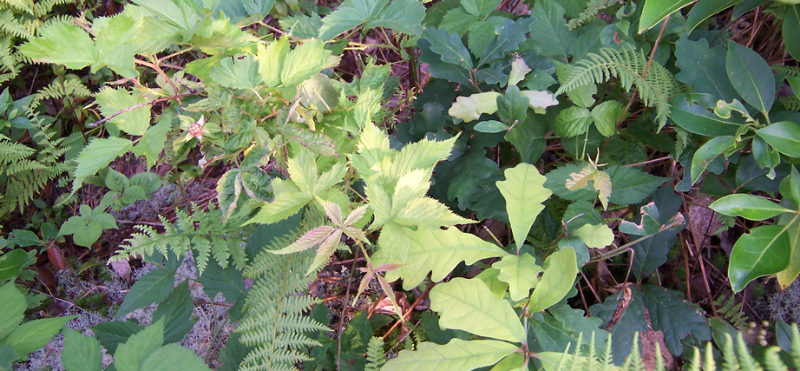
| Not so lovely Poison Ivy. Steer clear of it. |
 |
| Woodland Azalea |
In
conclusion, I have had such a good experience working with Avalonia,
and specifically Beth, this semester. It has been a lot of fun. I
hope that in the future I will be able to work again with the Land
Trust. I am sure that next year a new batch of GNCE sophomores will
take up the task of doing work with Avalonia, and hopefully someone
will work on the blog too. Just because the semester has come to a
close, that doesn’t mean that our work with Avalonia has ended. On
the contrary, we hope to work with Avalonia for years to come.
NOTE FROM
BETH: Thank you to Jessica for all your writing. And thank you to
all of these wonderful students. Each year I get bonded to them for a
short time. I have really enjoyed the experience and effort. It
has been truly rewarding to see some of the upperclassmen mentor the
sophomores, to make an effort to stay involved with Avalonia, and
keep what they learned close at heart as they move out into their
next phase of life and learning. Congratulations and best wishes to
all the students of GNCE, especially the graduates.
 |
| Quince |
Photographs by
Beth Sullivan.
Monday, May 2, 2016

Subscribe to:
Posts (Atom)