Showing posts with label birdbanding. Show all posts

Monday, November 6, 2017

Bird banding 2017

A note from the publisher:  Last Sunday night I was editing and formatting Beth's words and Rick's pictures into our weekly blog post for Monday morning. Outside the wind was howling and rain was falling; inside, the lights starting flickering and then failed completely.  No power; no post. We didn't get power back until Thursday evening.  So here is that post, a little late, because like it or not, technology needs power.


By Beth Sullivan
The nets were raised just after dawn. They were heavy with dew and needed to stretch and dry. It was really quiet. The birds were totally silent in the fields and thickets last Sunday when a small group of us gathered for an annual ritual-Bird Banding at Avalonia’s Knox Preserve.
As the sky brightened, we could sense a stirring. Some fluttering in the bushes, the chip notes of Sparrows in the grasses , different chips from Warblers , single notes from some, double notes from Chickadees.
We have been doing this for almost 30 years but the anticipation never changes; we are always excited to think of what may be in store for us on this first day of banding.

Morning catch

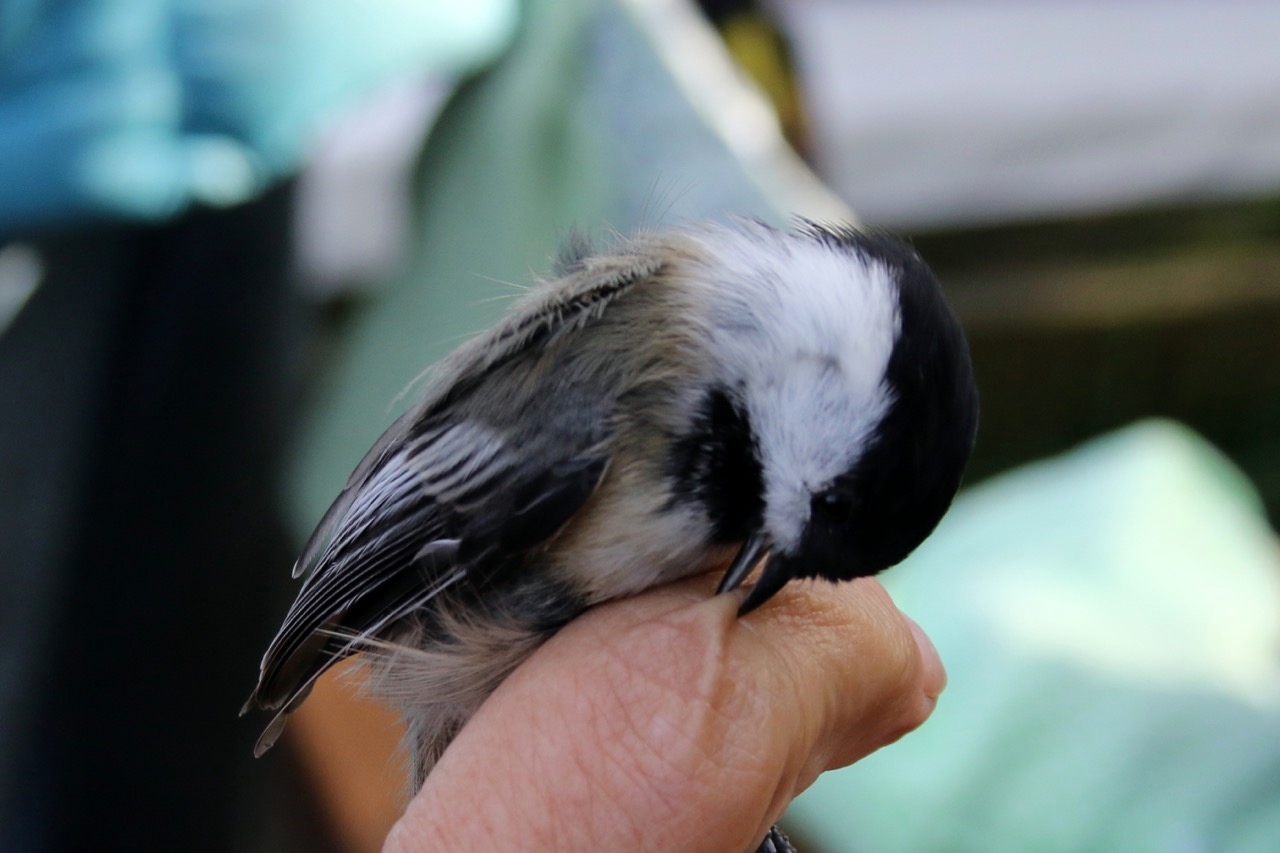
The nets are set up along the trails of the preserve. The perfect site is one with thicket rising on both sides of the trail. The dense vegetation is where the birds hide, and rest and feed. The nets are dark filament, and so fine, that they become almost invisible when one stares through them into the bushes on the other side. That’s what happens to the birds. They decide to fly from one side to the other, do not see the net, and get lightly caught in the mesh. Each bird species seems to react to this differently. The little Yellow Rumped Warblers, which are the most abundant birds at this time of the year, seem to just lay quietly; they don’t struggle and rarely get terribly tangled. Chickadees, on the other hand, are little dynamos. They fuss and fidget and grab the net with their feet. When we start to remove them, they peck mercilessly on our fingers.
Our first trip around the circuit always seems to produce the most birds. They are intent on finding food in the morning after a long cool night. A flock of about a dozen Yellow Rumped Warblers, flying generally together, all landed in the first set of nets. It was a promising start. There were several Chickadees requiring patience and gentle fingers, a Song Sparrow and, the big catch - a Blue Jay. When these big fellows hit the net, they often bounce right out. You have to get to it quickly and prevent escape if you want it on your list for the day.
Each bird is placed in a cotton bag or in compartment in a special box for transport back to our station set up with supplies.
Birds are trapped by fine mist nets.

Chickadees stay busy pecking through the whole process.

Removal from the net requires very patient fingers.

The actual process of banding itself is simple - the placement of an aluminum band on the bird’s leg, that will remain with it for life. It does not hurt; it will not impede, and it is like having a social security number on a bracelet. The bird is identified for life with a unique series of numbers. If it is caught again, or found dead, that number can be traced to the very place and date when it was first banded.
While we have the bird in our hands though, there is so much else to learn. We can determine a lot by looking at the plumage. Some young birds have different markings or coloration than older, adult birds. On the warblers, we look at the brightness of yellow patches and intensity of the markings. We also count the spots on the tail feathers.
Sometimes eye color is important. An adult Downy Woodpecker will have red eyes. We also measure wing length as it can sometimes tell us gender, but not always. To determine age, a small drop of plain water is used to spread the feathers on the bird's head to determine the amount of solid bone present. Like a newborn human, the young birds have a soft spot, a place where the bone in the skull is not closed yet, and it shows as a pink patch of skin, not white bone. We also weigh the birds. The weight is quite variable depending on recent food intake, or recent excretion. But it is all important data. It is a lot to keep in one’s head, but we have books with charts and guidance, and lots of practice.

Tally for the day

At the end of the day we had caught and banded 13 Yellow Rumped Warblers, 7 Chickadees, 2 Blue Jays, 1 Song Sparrow and a Downy Woodpecker. We did have a few escapees.
We also caught a Chickadee that already had a band on it. By looking back into the record book, we found that we banded that little bird on Oct 22, 2014. It was also caught again on November 4, 2015. To be recaptured on Sunday Oct. 22 2017 was quite a record!
For me, sharing the wonder of birds with others, especially children, is as much fun as handling the birds myself. To let a child hold a bird for the first time, to feel its light warmth and energy, to look in its eyes and make contact. It is something that child will hold onto forever.
The Blue Jay is the catch of the day.

This young male Downy Woodpecker shows off his colors.

To be able to hold a small wild birds is something she will likely remember for a long time.


Photographs by Rick Newton.

Monday, October 16, 2017

Coming and Going: Transitions

By Beth Sullivan
A couple of weeks ago, my hummingbirds left. Right on time- on the first or second of October. There are still flowers full of nectar, we haven’t had a frost yet, but the time and light was right and their migration began. For a few days the Downy Woodpeckers and curious Chickadees used the nectar feeder. Bird watchers in my area have noted this behavior over the last years and we wonder if it is a local learned behavior. These birds will stick around, but the hummingbird feeder has been brought in and cleaned for the winter.
I am always amazed at migrations. As a kid ( okay...and as an adult) I watched the timeless journeys of the large mammals in Africa, always in awe of the volume, mass and energy of the large herds. But I am even more in awe of the smaller creatures and their abilities.
As we lose our nectar-sippers, the insect-eaters are not far behind. While it is hard for us as lay people to know the difference between one Common Yellow Throat and another, science has been able to inform us that those that were born in our area are moving on, heading south, and those we may encounter now as we walk a wetland thicket are likely from more northern origins.
Goldfinches will be happy with wild seeds and birdfeeder offerings. Photo by Rick Newton.

Hummingbirds have fueled up and left the area.

Shorebirds, like this Yellowlegs, have an extended migration period.

More on the coast

Because we live on the coast, we have greater numbers of migrants. It is also known that most birds, especially the young of the year, migrate along the shore line. It might be a visual cue, maybe there is something atmospheric as well. But as they follow this Atlantic shore line, flying most frequently at night, they “drop out” each morning for their R&R in the coastal thickets and shrub lands. Hiking at places like Barn Island, Bluff Point, and Knox Preserve, or visiting off shore islands like Fishers Island or Block Island is a bird watcher’s heaven. Be on the look out for a great variety of fall warblers, thrushes, vireos, and others making their way south through this month.
Shore birds have mostly finished passing through here. The adult plovers, sandpipers, and other shore bird species leave their nesting areas in the far north well before their own young can fly. They also migrate along the shore line so local beaches are often alive with the small birds, picking through seaweed and resting up. Their young will follow up to a month later, usually following the same route, and often landing on the same beaches in South America as their parents. Bird banding studies have proven this, and now radio telemetry has made it even more accurate.

Flocks are forming

The Swallows are still massing before they roost every night, but that spectacle is nearly over. Our Martins left first, making their own flocks. In more southern areas, their roost flocks are so large that they show up on radar. The same occurs with the mixed flocks of Tree, Barn and Rough Winged Swallows that collect in marshes, most notably at the mouth of the CT River. Each evening they gather and swirl, and then settle to rest and ready themselves for their push southward.
From this, it sounds like we will be birdless shortly. Don’t despair. The sparrow numbers are already increasing in the grass lands. At Dodge Paddock, Knox Preserve, and Fennerswood, the weedy fields are full of chirp notes as they search for seeds. More northern finches will arrive and populate the thickets. It is time to bring out the seed and suet feeders. It is also time to think about Project Feeder Watch here, which gives us all an excuse to get out and look for the birds of Autumn.
The process of bird banding gives us greater insight into migrations. Photo by Rick Newton.

Nightly, thousands of swallow mass in preparation for their migration. 

Soon the Hooded Mergansers will arrive in local coves.

Sparrows are in abundance in local grassy fields.


Photographs by Beth Sullivan unless otherwise indicated.

Monday, July 17, 2017

Another Great Year for Purple Martins at Knox Preserve

By Beth Sullivan
Those of you who have read this blog for a while have come to expect a Martin update around this time of year. I have shared my journey and passion ( maybe obsession) with these birds for several years now, since our first grant award in 2013 from Audubon Connecticut, to start our colony.
Purple Martins are the only species of bird that is completely reliant on humans for their survival. We provide adequate nesting sites which are hollows, in a colonial setting. We just don’t have enough empty tree holes in close enough proximity to satisfy the needs of dozens of pairs of these birds. Since pre-colonial days, Native Americans provided natural gourds for Purple Martins. Now there is an entire industry built around attracting and providing for colonies of these birds, and the effort has brought the species back from the brink of being extirpated from many areas.
Perfect habitat for Purple Martins can be found at Knox Preserve.

The Knox Preserve colony

At Knox Preserve we provide two set ups, totaling 24 gourds. A close neighbor has a classic Martin House also hosting 12 pairs. Since the end of April, when we set up the housing, we monitor it. Early scouts come to check out the area. Mature birds come first, usually males, to stake out their spots from previous years. If they have a successful breeding experience in a location, they will be very loyal to their site. Females join them, and then younger birds, the hatchlings from the previous year, return later. They often find no room at the inn, so they are likely to fly farther looking for new colonies and vacancies.
As Martin landlords, we have teamed up with the DEEP to band these birds each year for the last four, in order to be able to identify and study them as they move between nesting grounds and wintering grounds in South America. By fitting them with an aluminum band with a unique number, much like our Social Security number, these birds are identifiable as specific individuals. That number is often difficult to discern, however, color banding is a way to visually mark these birds so they can be easily traced to a particular colony. Each colony in CT has a unique color combination: Ours at Knox is Orange/Green. Nearby Pequot Golf Course is Orange/Blue. It has been very easy to see when our populations intermingle, which is great.
The banding team weighs, ages, and assesses health, as well as placing the bands.

Showing off its new bands, this little one goes back into the nest.

On a blazing hot, humid day last week, the DEEP team arrived at Knox Preserve, efficiently set up their work station under a tent, and got to work. It was our job as landlords to get the birds out of their nests and delivered to the table for processing. It is a very precise practice using Coolwhip containers with little handmade liners for transport. Each individual was weighed and observed carefully for development in order to assess age and overall health. Our Colony had birds that were as old as 19 days, yet we had one nest that was only hatching that day - way too little to band.
A beautiful, typical nest.

These are day-old hatchlings.

The birds were fitted with bands and all data recorded accurately to be later added to a full database for all colonies. Each little one needed to remain with its nest-mates and returned to its exact nests in an appropriately marked Coolwhip container. The parents waited patiently, often with an insect in their mouths, ready to fill a hungry mouth on return.
These are about a week old.

Several of us had done this process a number of times, yet it never ceases to be amazing. This year we had several new observers, including a two year old who was able to peek inside the nest and see the babies and even touch one. Other volunteers were able to participate in the banding process. It doesn’t matter how old you are, or how often we do this, it is always so awe-inspiring.
It takes a lot of work, to prepare nests and monitor them frequently, to collect data even before the banding day. Cleaning out the gourds at the end of the season is really an awful job. But getting to see my babies fledge and fly off to the nearby trees makes it worthwhile.
They get little feathers before they are two weeks old.

It is even better to spot one with Orange/Green color bands , coming back to the colony it where it was born, and calling it home again.

Photographs by Kent Fuller, Beth Chapin, Jim Sullivan, and Beth Sullivan.

Monday, July 25, 2016

Purple Martin update from Knox Preserve 2016

By Beth Sullivan
On this beautiful summer evening, I took my binoculars over to the colony at Knox Preserve to enjoy Martins at sunset. I was rewarded with lots of song and chatter as I realized I was witnessing a special event: Fledging! It was a perfect time for the “godmother “ of this colony to reflect on the season.

Rough start

We had our first scouts at Knox earlier than past years, so the gourd housing went up mid- April rather than a week or two later. We had at least eight birds inspecting the site right away, off to a great start. Then came the wicked spell of cold weather in very early May. Insects did not fly and the martins, unable to eat seeds or berries or man -made offerings, had to huddle for warmth and survival. All across the area Martins died. We found one, a bird banded in a Clinton colony, dead on the preserve. We all worried. But a second wave of migrants arrived, the weather warmed, insects hatched and took to the air, and the Martins were happy.
A perfect nest, lined with leaves and seven eggs.

Nest making followed quickly and we could tell egg laying was imminent when we watched them bring their green cherry leaves in to add the final lining to their nests. Then came the eggs, sweet, pure white. The average clutch was about five eggs, but one nest had seven.
Hatching day. A parent will remove the egg shells.

The birds are very tolerant of human disturbance, and each week I lowered the gourds to peek in and count eggs. The first were laid on June 1, but the action continued through June 24th. We had quite a wide span which meant that hatching would be spread out as well. Several times over the first weeks we lowered the gourds, checked on the young, cleaned nests if they were infested with mites (only a couple were infested this year) and recorded our numbers. We ended up with a grand total of 68 eggs. Of course, not all would hatch, but it was a great starting point.
Nestlings are transferred to containers to wait their turns.

The DEEP Martin banding team schedules their efforts when the young are big enough to band (about a week old) but before disturbance might cause them to “jump” or fledge prematurely, around 23 days.
On July 5th, on a sweltering hot afternoon, the team came to Stonington. Volunteers from Avalonia helped out at Pequot Golf Course where the colony is very well established and very productive. At least 80 young were banded there.
The young are aged against a photo chart.

At Knox a tent was set up out near the field where neighbors and friends joined the effort as each gourd was checked. The young were removed safely to hi-tech, cloth- lined “cool whip containers “ for transport to the banding table. Each was labeled accurately so we were assured that each nestling returned to the proper nest. The young were aged against very detailed charts, they were weighed, and had bands affixed: a metal federal band with a long identification number, unique to each bird. Then two plastic color bands were placed on the other leg. The colors are easy to see and enable an observer to record and then determine which colony the bird came from. Ours at Knox have Orange/green bands.

Successful afternoon

At the end of the afternoon we had banded 47 of our youngsters, with one nest full still too young to band and another nest of eggs still not hatched. We also banded 28 from our neighbors , technically considered all a part of the same colony.
Fledgelings still need to be fed. Photograph by Rick Newton.

Over the last weeks since banding, I have not lowered or opened the gourds. It is a sensitive time, and the birds close to fledging can be startled into jumping too soon. So all I can do is watch with binoculars.
Tonight was a treat. There were at least two families of Martins in trees close to the houses. Parent birds still bringing food to their newly fledged young. But what was also fun was observing all the little faces and beaks, peeking out of the entry holes, maybe not quite ready to make the leap, maybe waiting for one more cozy night, but maybe tomorrow could be their big day.
An almost-fledgeling trying to decide if the time is right to make the big leap. Photograph by Rick Newton.

Like a true “godmother” I wished them safety, soft landings and strong wings as they make that leap of faith.
With luck, you can spot the color bands on one of our birds. Photograph by Rick Newton. 


Photographs by Beth Sullivan, unless otherwise indicated.

Monday, November 2, 2015

A bird in the hand is great, but keep an eye on the bushes

By Beth Sullivan
This is an active time of year for watching birds. Many of our summer residents have left the area, long gone to warmer climates, that are more supportive of the insects and fruits or nectars they require. The Hummingbirds, Orioles, Tanagers, and Flycatchers have been gone a while. The aerial insectivores, the Swallows, and our Purple Martins hauled out beginning in August and though September. Before they left they provided many of us with spectacular displays of roosting behaviors.
We are still seeing many migrants though: Birds from farther north, still on their way south, but using the coastal route, they stopover along our shoreline shrub-lands, forests and fields.
Holding a Cardinal can be a challenge and a hazard

This is the time we set up for our fall banding operations at Knox preserve.
This year we have had other studies of the birds ongoing there since the spring. The Trinity College team that has been studying at Knox has expanded their efforts to include birds. For several years now they have been studying our efforts to eradicate non-native invasive plants and restore native grasses and shrubs where we can. They also decided to collect data about the effect the efforts may have on bird life as well.
It's nearly impossible to spot birds in the tangle of protective vines

Knox bird survey

If you have walked Knox, you will have noticed wooden stakes with pink flags and metal tags, these are the 22 bird survey sites. Through the summer a team of students arrived at daybreak to do a very precisely laid out investigation of the species that use each site. The survey has continued through the fall now, with others of us gathering gather data on the birds that now use the site as a migratory stop over or as wintering grounds. The observations include vocalizations, songs and chip notes, as well as sightings of the birds at each area. This can be pretty difficult as Sparrows, in particular, tend to pop up, then immediately fly down into the tall grasses, making counting and identification really difficult. The dense thicket areas, the main attraction there, provide great hiding and protection, and also make spotting the flighty creatures difficult. To make it harder still, the birds just don’t sing in the fall like they do in the spring, so the survey has been a challenge.
Each circle represents a bird survey station

Long history of banding

The other technique to sort out the birds in an area is to catch them! We have been banding at Knox for nearly 30 years, so there is a large body of data available. Read about a previous banding here. This year we had hoped to have our special Avalonia day of banding on October 25, but the weather did not cooperate. We cannot do it even in the lightest rain as it is really dangerous for the birds to get wet to the skin; feathers clump, nets sag, and no one is happy!
A Yellow-Rumped Warbler caught in a mist net.

We did, however, set up the nets this week, as we wanted to get some consistent data for this period. On Monday Oct 26, it was clear and cold and sunny. The birds were active and in less than 3 hours we had captured and banded about 30 Yellow -Rumped Warblers, the most abundant fall migrant through this preserve. We also caught 3 Cardinals, a Song Sparrow and 2 Black Capped Chickadees. The surprise of the morning was that one of the Chickadees had a band already! By checking our back data entries, we discovered that the Chickadee we caught that day had been caught at Knox preserve last year on October 19th.
Song Sparrows are masters of hiding in grasses.

So that was a great day! The very next day we set up again, nearly the same conditions, and not one single bird was captured!!! Go figure. Maybe it was that hawk we watched …watching the nets!! Enough to spoil any little bird’s day!
White Throated Sparrows are here for the winter.


Photographs by Al Bach, Rick Newton and Beth Sullivan.

Wednesday, October 8, 2014

Art of Conservation, October 18 and Bird Banding, October 19

Art of Conservation, October 18


There's still time to get tickets to the Art of Conservation at the Mystic Arts Center in Mystic. This event supports Avalonia's conservation work.  Won't you please help us continue our work? Tickets are available on-line here. More information about the event is at our recent post, here and in the flyer, below.

You can still volunteer to help by contacting Heather Milardo in the Avalonia office, by email (avalonialc@yahoo.com) or phone message (860-884-3500), to let her know what you can do.

Bird Banding, October 19


After an evening of looking at nature's beauty captured by talented artists, you can see nature at close range with your own eyes, Sunday, October 19.  Please join Avalonia for a bird banding event at the Knox Preserve in Stonington.  Located on Wilcox Rd. off Route 1, we will gather at 8 AM to weigh, measure, and band resident and migrating species.  This is a great opportunity to photograph birds in fine detail without expensive equipment.  You can read about last year's event in our post, here.


White-throated Sparrow about to be released after banding.


Monday, July 14, 2014

Another successful year for Purple Martins

By Beth Sullivan
Those of you who have been reading this blog for a while have by now realized I am quite fond of (addicted to maybe) my little colony of Purple Martins at the Knox Preserve. In all fairness, they are not “mine” but shared with all who enjoy the Knox Preserve and are a direct result of two Audubon IBA ( Important Bird Area) grants we have received.
Adult male(L) and female wearing bands from last year.
Knox fields, great for insects, great for Martins.

A Flying Snackbar

In the last two years we have managed the habitat at Knox so that the fields are lush with a variety of grasses and flowers that attract all sorts of insects. The aerial insects are what attract the Martins, as they only catch their food while flying. While it is a myth that Purple Martins are great consumers of mosquitoes, they eat all manner of flies, grasshoppers, flying ants, dragonflies and butterflies too. I guess we have to accept they eat some that we actually enjoy ourselves. While doing some research, I discovered that there are literally tons of insect/invertebrates that are caught up in the air column-even those that are not supposed to be in the air! Martins have been seen bringing non-winged ants and other non-flying insects into their nests. It is known that they do not hunt on the ground at all, even when nearly starving!
Since the end of April this year I have been monitoring the two sets of hanging gourd nests. These are equipped with crescent shaped entrance holes that deter starlings. They also have little “porches” on the outside, and in the new set on the inside also, to aid the adults in landing at the entrance and feeding the young. The birds seemed to like the new set better this year, as we had more nests in the newer ones than the set we erected last year.
Over the last months we watched the birds as they constructed nests, by lowering the sets to peek inside. Martins will use a variety of materials depending on what is available. We start them out with clean dry pine needles; they add small sticks and grasses. Several had seaweed/eelgrass, and they often use mud. Once we saw them arranging green leaves, we knew egg laying was near.
We used a diagnostic tool to compare when the first eggs were laid and anticipated when hatching would begin. An average clutch was 5 eggs. The first nestlings hatched around June 19, and continued through June 27, each nest being different. Most often all eggs in a nest hatch at the same time, but developmentally there are some real differences as they grow.
On Wednesday July 9 a team from the DEEP came out to band our birds. Avalonia volunteers joined DEEP volunteers and we met first at Pequot Golf Course on Wheeler Road. They have a very successful and mature colony and have produced over 90 young in 24 nests over the last years. Our nests produced 33 healthy young, and we added another 28 to our tally by including a neighbor’s Martin house occupants! That is considered a huge success for a new colony.

Banded for Identification

It is an amazing opportunity to participate. Each nest is identified with a number. The birds are removed from each nest into marked containers. It is essential that they are returned to their exact nest once banded. Each bird is fitted with a metal federal band with a unique number that will identify it for life. They are then given color bands on the other leg. Our colony has green/orange or green /yellow added this year. With binoculars the colors can be seen and the bird can be identified as from a particular colony. Pequot Golf Course has had blue/orange since last year, and this year I discovered one sub-adult female bird from Pequot had chosen to nest in our colony!
Removing the young and noting the nest number.

DEEP and Avalonia volunteers staff the banding table.

This Martin sports new colored bands.
The young are weighed, and their ages are determined by looking at feather development. Once all is recorded they are nestled back into their gourds, and they settle right in. The parent birds are waiting patiently, their beaks full of food for their hungry young.
This one is about nine days old. The feathers are barely coming in.

This one is closer to 16 day old with much more feathering.

The oldest hatchlings will fledge in another week. Others following suit over time. They will remain in the area, learning to catch their food and often return to roost in their nest gourds for a while. All too soon they will gather and fly south, well into South America, for the winter. We will await their return eagerly next spring and look for their color bands.
Adult Purple Martins return to their own nest, awaiting their young.

We are very grateful for the DEEP team, and all the volunteers that showed up at both sites. Many hands made faster work, and we got a bit dirty, but the experience was surely worth it.

Photographs by Beth Sullivan.  

Monday, October 28, 2013

A Bird in the Hand……..Is really a wonderful experience!

Early on Sunday morning, Oct 20, a group of citizen scientists converged on the Knox Preserve to join Federal bird banders Bob Dewire and Beth Sullivan for a morning observing the process ornithologists use to study and track songbirds. The process was new to several observers, but has become a rite of the Autumn season for several others present. 
White Throated Sparrow about to be released after banding.
Over two decades of banding records have been compiled for the Knox Preserve where we have studied mainly the migratory birds. Some are just passing through, others arriving for the winter, but of course there are several species that remain year round. During the fall, many species of songbirds fly south following the visual line of the coast line. Many fly by night, and at first light, they seek out a welcoming patch of shrub-land for food, cover and rest. Knox Preserve provides that oasis along a very densely populated coastline.
On several days during October, at the peak of migration, mist nets that are seven feet high and forty feet long are strung up in the pathways through the shrub area of the preserve. These nets are nearly invisible to the birds as they move from area to area in search of food. When they encounter the net, they drop lightly into the mesh pockets and usually remain quite still.
On Sunday we set up five nets at dawn. By the time the group arrived, it was time to make our first rounds of checks. When we approach the nets, it is always a bit like Christmas, eagerly anticipating the treasures we will encounter. We have had some wonderful surprises over the years, from Endangered Species rarities , to hawks and owls. Mostly they are a variety of songbirds that use this habitat for forage. Birds are gently removed from the nets and placed in a special box or small bags and then transported to the station set up with our supplies.
Removing birds from the nets.
Birds in bags waiting for banding.
This Sunday morning was quite successful. In a very short time we captured 26 birds and as all observers were quite quick to note, almost all of them were the same species: Myrtle Warblers, otherwise known as Yellow Rumped Warblers , for the bright yellow patch of feathers on their rump! This is their peak of migration and the big draw for them at Knox is all the berries they can find. Many warblers are purely insect eaters and have had to move farther south as it got colder, but the Yellow Rumps adapt and thrive on berries, some remaining in CT even over the winter. They especially love the Bayberry and waxy Cedar berries that are especially abundant this year.
Yellow Rumped Warbler.
The banding process itself involves placing a light weight metal band on the leg of each bird. Each band has a unique series of numbers, much like our social security number, which will remain with that bird for its life. If it is caught again, or found dead, the band number can be reported and traced. A Gray Catbird, banded here in Stonington was found dead in Guatemala. A small warbler, an American Redstart, was banded here and only several days later was re-caught in the Bahamas! Quite the traveler.
Placing the band.
While we have the bird in hand, it is an opportunity to measure and record other data about the individual birds. All this information is dutifully entered into a USFWS banding database. We determine their gender, when possible, by looking at plumage and sometimes taking certain wing measurements. As on a bell curve, the very smallest of a species of songbirds are often the females, the largest, the males, but there are a lot in the middle and there is just no way to tell male from female, unless you are another bird!
Checking plumage on a Yellow Rumped Warbler.

Measuring the wing chord.
We weigh the birds; every little berry counts for these lightweights. We can also determine if they are the young of this year by checking the skin beneath their feathers on their head. A young bird’s skull bones are not fully fused yet, and the skin will show pink. An adult bird will have full bone cover on their skull and the skin will reveal white beneath.
Weighing a newly banded bird.
Each participant was able to hold and band and do most aspects of the review of these little treasures. Then they were released to the bushes with just a few chirps and mutters, to return to foraging, no worse for the experience.
Song Sparrow about fly away.
In two days this season, we captured and banded over 100 birds. They included Song Sparrows, a White Throated Sparrow, a Red Eyed Vireo, a Common Yellow Throat, a Black Capped Chickadee and over 90 little warblers with the bright yellow rump!
Written by Beth Sullivan.
Photographed by Rick Newton and Al Bach.


For more information about the Federal Bird Banding program visit  USFWS Bird Banding Lab's website here.