Showing posts with label Knox Preserve-Stonington. Show all posts

Monday, July 20, 2020

Some things don't change

By Beth Sullivan
Having been the grandmother to the Purple Martins at Knox preserve for about seven years, I really look forward to every season and have come to know the stages of development that take place inside the secrecy of the nests. The miracle is just too wonderful not to share.
The scouts stayed with their parents, properly distanced and masked. Photograph by Rick Newton.

A little different this year

This year, with all the Covid concerns, just two of us have been monitoring the nests, and we haven’t been able to share the experience with anyone else. But last Sunday, everything aligned just perfectly, and I was able to introduce a new generation of Cub Scouts to the newest generation of Purple Martins on the Knox Preserve. Pack 37 of Stonington, under the leadership of Matt Ferrier, has helped out Avalonia on several occasions. With extra muscle from parents, they planted seedling trees on the Woodlot Sanctuary and have helped restore walls, make brush piles and clean up in Hoffman Preserve. It was time for their reward. With only a short notice to determine the weather would be ok, and several families would be available, we set a time to meet.
Five Scouts, each with a parent or two, and even a grandmother, arrived right on time. They spread out , properly distanced, and I was able to give them the first guidelines: listen, stay distanced, and always keep your mask on as there would be times when I would be close to them. We walked out the path to the colony site, and the martins could be seen soaring against the perfectly blue sky. We could watch them capture butterflies and dragonflies and return to their nests to feed their young. I had monitored them closely enough to know the age and stage of development of the nestlings in each gourd, so after watching me crank the winch to lower the set up, the boys could barely contain their curiosity. One by one, with their own parent, they carefully climbed the step ladder to be at the perfect height to peek into the first nest. Last time I checked, there were still eggs; this time there were three eggs, and one tiny pink nestling, just hatched. One of the scouts actually found the eggshell on the ground. Everyone, parents included, took a turn. Just amazing.
The first peek inside a nest. Photograph by Sandy Alexander

The first nest was amazing. They got to see a brand new hatchling.

Behind the mask they were grinning ear to ear.  Photograph by Rick Newton.

By comparing the live bird with the chart we could determine its age.

A hands-on experience

Then we moved to the next nest. Here the birds were about 9 days old. Using the growth chart provided by the Purple Martin Conservation Association, we were able to compare the live bird with the photos and look at feather development on its wings and tail to determine its age. Then, several of the scouts got to hold this bird. Ever so gently they cupped the creature inside their hands. They could feel the warmth, touch the stiff pin feathers and even see the holes in the head that are the ears. Over their masks, their eyes just popped with wonder. During the next half hour or so, others had a chance to hold different birds, use the chart to compare, ask questions and beg for more turns. They were hooked. As Scouts, they were ready and willing to help, so as we finished the first set of gourds, they stepped up to help me crank up the winch to raise the set high on the pole.
There were even more birds of various stages in the second set. More opportunities to peek inside. And when we found a wonderful nest of 4 newborns on the upper level, their parents helped lift them up to look. When the nest was jostled, the birds would raise their heads and open their really huge mouths, hoping for a morsel. Even with such large mouths, we were all wondering how a parent could deliver the biggest dragonfly we had ever seen, into one comparatively small mouth.
After they helped me crank up the last set, we all sanitized our hands, and they had a Scout mini-meeting in the field, still well distanced from each other. Before they left the field, each turned to witness that the parent birds returned very quickly, not at all disturbed by our activities, to feed their hungry young ones.
With a few adjustments, this event went on as it might have at any other time. The sun was shining, it wasn't  too hot, and the sky was a beautiful blue. The birds and insects carried on as normal. It is so reassuring to know that some things do not change.
The Scouts listened well to instructions and held the birds very gently. Photograph by Rick Newton.

We wondered how the little birds could eat a dragonfly this size, even without its head. Photograph by Sandy Alexander.

The parent birds waited patiently with their beaks full. Photograph by Rick Newton.


Photographs by Beth Sullivan unless otherwise indicated.

Monday, December 2, 2019

Communicating the value

By Beth Sullivan
Avalonia is a land trust. It conserves, preserves, and protects land and natural habitats. The other half of our mission is about communicating the value of these resources that once protected, will remain protected forever.
The Avalonia team works to communicate and educate in many different ways. This blog is one. We use social media such as Facebook and Instagram to convey our message. One of the best ways to really learn is by getting close to the subject, getting out and hiking, getting on your knees and looking closely, or joining a guided hike with a leader who can help teach.
Dealing with stronger storms and higher sea levels will be a topic of study for many.

Hoffman Evergreen Preserve hike

This past Friday, Black Friday, we challenged the turkey-filled to avoid the malls, and get out and hike. I have written extensively about the Hoffman forest restoration project. So, on Friday, stewards Jim Friedlander and Rick Newton, who are closely involved with the effort, joined by Phil Sheffield, a hike leader, and Sandy Alexander, our communications wiz, took about 50 people, kids and dogs as well, on a hike through the Hoffman Evergreen Preserve. Many hours of effort had already gone into getting the area more user-friendly: new blazes were painted on trees to be more visible and reduce confusion, and miles of trails were cleared by hand to remove large and small debris for safety and easier walking. With recent winds and rains, trees continue to fall, so chainsaw teams had gone out to remove even more blowdowns. Hikers had an opportunity to see the project and understand the planning behind it, as well as hear our hopes and plans for the future. Getting people to understand the issues, and become engaged with a project, allows them to feel like a true part of our conservation efforts. We will be calling on some of these same folks over the next months to help us with work parties.
Led by Jim F., hikers of all ages enjoyed the walk a Hoffman Preserve.

The pond a Hoffman Preserve remains full to the brim.

Some of the projects spreading our message

Some of us work with individual students to give input on projects or take on groups, from Cub Scouts to College students, to assist with educational efforts.
Cub Scouts planted seedling trees on The Woodlot Sanctuary. It is my hope that some of them will thrive so the kids can return years from now and locate them.
Maggie DeFosse is studying environmental policy and doing her final college internship with Avalonia. She remembers many years ago when I was doing classes in her elementary school and now has come full circle. We are working together.
This past week I met with a student from the Williams College Marine Program, to discuss coastal resiliency. He knows Avalonia has a number of coastal properties, including islands, and wonders about our plans for resiliency. He has studied our efforts at Dodge Paddock. He is concerned that there isn’t a state-wide plan to work together with towns and land conservancies and other agencies to address the looming sea-level rise crisis. He had some great thoughts, but in this case he will literally have to fight multiple city halls because each municipality in CT has its own rules and zoning plans.
I am working on scheduling a hike with a 13 year old, Gabriel, who is going to do a school project that will be educational, scientific, and oriented for community education. He has been inspired by hiking with naturalist Bruce Fellman. I will help him explore Knox Preserve, with a focus on how wildlife can prepare to adapt and survive the winter ahead. Once he gets the introduction, he will create his own educational hike and lead a group of his peers on a tour of the preserve to teach them what he has learned. Now, if the weather would cooperate, maybe we can get out next Sunday.
The program with Connecticut College's Goodwin Niering Center for the Environment, will begin in February. It will be yet another opportunity to educate smart young people about what we do as an organization and to learn from them as well.
These are the future stewards and policy makers for our world. Some will stay close to home, some will range far. All will, hopefully, see that their time with Avalonia helped shape their ideals and goals for the future we all share.
At Knox Preserve, we will discuss adaptations to survive the winter.

Connecticut College students are willing to get their feet wet.

Cub Scouts plant tree seedling. A hope for the future.

A fox den at Knox Preserve.


Photographs of Hoffman Preserve are by Phil Sheffield and Sandy Alexander. All other photographs by Beth Sullivan.

Monday, July 15, 2019

Purple Martins 2019

By Beth Sullivan
This is our sixth year monitoring and stewarding the purple martin colony at Knox Preserve. I always start off the year with so much optimism and high hopes. The season started out great, with reports of scouts in the area as early as April 11th. We took the hint and got the first set of gourds up on April 14th. There were birds on the pole as soon as we pulled up the gourds. The second set went up soon after. The first days and weeks are all about scouting, with mature birds returning first, to territories they are familiar with and often taking first choices on their nest sites. We were enthusiastic and guardedly hopeful.
The adult males are usually the first scouts and arrive early to stake out their favorite spots.

Nests are complete with a cup of green leaves ready for the beautiful eggs.

A wet Spring

Those last weeks in April and early May were really wet. It was cloudy, cooler than average with frequent rain, and often even when it wasn’t raining, it was foggy and damp. That was not good. The insects that are the staple of the martins’ diets were not flying. Martins tend to feed at higher altitudes than other birds so maybe those closer to the ground and tree tops were doing ok, but the high flying dragonflies and butterflies were just not there. This had at least two bad effects. Many martins simply kept moving north. If it was too cool and damp at the shore, apparently inland sites were more acceptable, so they settled there. Lack of food weakened the birds, and their attempts to find mates, make nests, and establish themselves were less than successful in many cases.
In mid-May I like to try and check the gourds, to see if there is sign of nest building. This is simply extra material added to the pine needles I supplied. I was happy to find several enhanced nests and see birds in the area. However, we also found a pair, dead, inside one of the gourds. The female was actually banded and identified as one who had been born there at Knox several years earlier. When I reported to DEEP, they confirmed that it was likely due to the cold and wet. They likely had taken shelter together in the gourd and just starved. I was devastated.
Over the next weeks we watched and waited. The weather improved. A number of the gourds were filled with nesting material, but not nearly as many as in previous years. One sign I always look for is the addition of green cherry leaves to the central part of the nest. There are several thoughts about why the birds do this. Some believe they are insecticidal and deter mites. Out of our 24 gourds, we had 11 nests completed with green leaves, less than half occupancy. Meanwhile, reports from friends with inland colonies in Ledyard and Norwich, seemed to have an overflowing abundance-full houses.
Our first eggs were laid around the very end of May. The female will lay one egg a day until her clutch is completed. The average number of eggs is five, but occasionally six or seven can be found. There are instances of a second female sneaking an egg into an established nest. This will result in one hatchling being of a noticeable difference in size. Hatching begins about 15 days after the last egg is laid. Our nests were created over quite a wide span of time, and thus the eggs were laid over quite a long period within the colony.
We also had a few mysterious and sad occurrences. On two separate occasions, a nest was discovered completely empty of eggs. After being full on one check, a week later all were gone. We have predator guards against snakes and raccoons, so this predator may have been another bird. We have had problems with house sparrows ousting martins. This may have been the case.
In the other gourds, hatching began mid-June and has continued. We even had one new nest full of eggs at my last check July 8. I wonder if it was from a pair who lost their eggs early on.
They go from pink and helpless at hatching to feathered and alert in just a couple of weeks.

One of these birds is several days younger than the rest. It may have been an egg from another female.

Between two and three weeks of age, when the shiny blue-purple begins to appear on their feathers, they become more active and I stop monitoring them.

Egg to flying in 21 days

We are nearing the end of the time for checking nests. As the young ones go from pink and helpless, they grow rapidly with noticeable changes on a daily basis. The feathers emerge in predictable patterns so we can estimate age more accurately. Once they get to about 21 days old, they can become quite jumpy and could leave the nest before they are ready, so we do not peek as often. Usually though they are tolerant of disturbance and have gotten used to the intrusion and behave quite calmly. The parent birds always stay near, often waiting with an insect meal in its mouth.
At last count we had nine successful nests with a potential of 35 young. While I am a bit disappointed, I know that some of the inland colonies did very well this year. CT Audubon and DEEP report that due to caring stewardship of purple martin colonies, the birds are faring far better than they have for decades.
There are numerous online resources about purple martins, including one on the CT DEEP website. Check them out. You might get hooked.
This was just an off year, but I am happy with my small success. There will be next year, and hopefully these little ones will return and give me some full houses.
The Martins fly high to catch dragonfiles and butterflies to feed their young.

When the nest is jostled a bit, the young respond by opening their beaks, expecting a meal.


Photographs by Mariano Librojo and Beth Sullivan.

Monday, March 4, 2019

Planning with Natives: a Snowy Day Tonic

By Beth Sullivan
As we sit and await yet another snow event, I can’t help but wonder if the groundhogs were wrong. The best antidote to a snowy day is a trip to the mailbox to discover some seed or plant catalog full of colorful and enticing entries, bound to warm one’s soul, and warm up the credit card.
A while ago I began to switch my own gardening choices to more native plants. Not always, but more often now than when I first began to beautify the barren landscape we found when we first moved here. My yard and gardens are pretty full, and now I am looking to downsize a little, make things easier. However, I have become involved with landscape restoration on larger scales for Avalonia. We have had a number of projects over the last many years, where we were often getting rid of invasives and then re-planting.
Choose local native flowers for their amazing colors.

Native plants can truly be more beautiful than a cultivated garden.

Clearing out invasives

At Dodge Paddock, the effort is ongoing. After the Phragmites were mostly eradicated ( they are so persistent), we replanted much of the areas with plugs and seeds of native Spartina marsh grasses. In just a few seasons, those grasses have behaved like they are supposed to in their home habitat: they have grown and spread and colonized all the appropriate areas, re-creating a normal and more healthy salt marsh. In doing so, it is attracting far more wildlife, of all kinds, to the area. We were told that Mother Nature would accomplish this on her own, but with funding and energy, it sure was gratifying to give her a hand and a head start.
At the Knox Preserve, we cleared out the southeast corner that was a tangle of an entirely non-native, invasive mess. Granted, it served as some habitat for animals and birds, but the quality was not there. It has been proven that a bird may be very happy eating a berry of a non-native or ornamental plant, but the quality nutrients are not nearly the same. This can pose a real problem when birds expend a lot of energy foraging and not getting the nutrients and calories they need. It is much the same with bees and pollinators. They may be less attracted to non-native flowers and therefore need to fly farther and longer to find their food sources. If they choose to indulge in a non-native nectar source, it may suffice in the short term, but once again, the quality of the nutrients is not the same.
Birds, bees and native plants evolved together. They rely on Nature’s time clock to hatch and feed young and find food according to the stimuli of the seasons-temperature and daylight hours. Non-native plants do not always follow the same timetables.
At Dodge Paddock native marsh plants have established diversity and wildlife flourishes. 

Native viburnum berries are for more nutritious for birds. 

Pollinators survive better when native plants abound.


A true native environment

We are beginning to plan for the Hoffman Evergreen Preserve project. We know that once the heavy work is completed, there will be areas in need of restoration. We also know we will need to give Nature a hand again. Leaving areas open to sun after disturbance is a big open-arm welcome for invasive plants to establish. They are always the bullies of the plant world and will out-compete the natives in every aspect. We need to fill that void quickly. Already we are looking at our options: native grasses, herbaceous plants, shrubs, and trees that we can use to replace and restore what has been removed. It is essential that we find true native resources to do so. In a home garden or a smaller landscape garden, it is OK to use occasional ornamental plant. There are also many wonderful native plants that have been developed by plants-people, to be more floriferous or often prettier than the true natives. These are called cultivars and often have names following the species in the label. These are good choices for the home gardener working on establishing basic native gardens, but even these pose problems when it comes to longer term stability in a larger landscape. For Hoffman, we are looking for true natives, the kinds that have grown here always. They will be pollinated by native pollinators and their seeds will be true to their species. It will be the first steps to restoring a forest that will last for generations.
So on a snowy day, I am not only looking at seed catalogs of luscious vegetables and amazing flowers. I am learning more about our own native plants, trying to find where they can be purchased, and think ahead to a bigger garden landscape. A whole forest.
Take a walk on the real wild side. Plan your gardens with natives.
Porcelain berries may be beautiful, but they are not a valuable food source for birds.
Porcelain berry vines invade and smother whatever is in their way.

Photographs by Beth Sullivan.
You can find out more about native plants and pollinators at these websites:

Monday, August 13, 2018

Fledging

by Beth Sullivan
It happens to all species. Kids: you give birth, take care of them, feed them, clean up after them, teach them whatever you can, wish them well and then they are out the door. Sometimes they hang around a while. Sometimes they need more instruction, or just can’t find a place of their own, so return to roost.
Lest I get too far with this and you think I am talking about my own offspring…no, it is my Purple Martins again. This is the sixth year we have hosted Purple Martins at Knox preserve. Each of the first two years we were the recipients of an Audubon CT grant that funded the two lovely set ups of 12 gourds each, made especially for the Martins. Each year our colony has grown and each year has been very unique in one way or another. Each year I learn more about them, and each year there are surprises.
This year the birds arrived on time but actually began nesting earlier and in those first nests, eggs were laid a full week earlier than previous years. However, there were still stragglers. The youngsters from the previous year, or from other colonies, that arrive later and take what is left for space, get started later. That made for a colony that had a very wide span of ages of young once they began hatching.
A wide range of ages existed in the colony. These were about 11 days old on the same day the next door nest was just hatching.

Our Tree Swallow nest has three young in their feathery nest.

These four seem fully feathered and should be able to fly, but stayed put when the door was opened. Photograph by Mariano Librojo. 

Different nest building this year

Some of the nests were very unusual this year too. Most Martin nests are quite light and loose. They are created on a base of pine needles that I supply and are supplemented with other grasses, sometimes small twigs, and always lined with green cherry leaves which indicates egg laying is imminent. This year I discovered several nests were created with a lot of mud. Mud itself is not uncommon, but the volume used in these nests was surprising. Nearly half of each gourd was filled with it and straw embedded into the mud, before the green leaves were added. This didn’t seem to cause any problem for the birds, but for me as the care taker it was a challenge. Usually, when the young are about 10 -15 days old, it is advised to check them for mites, since these can be so numerous as to kill young birds with their blood sucking habits. I would do complete nest changes, removing old infested material and replacing it with new clean needles and green cherry leaves. But it was absolutely impossible to remove the jam packed mud. These nests did have insects living in them and as the heat of the season built up, these mud nests seemed to hold the heat and moisture making what I would think was a very uncomfortable environment. These nests, by the end of the season, were filled with excrement and insect parts. I’d want to fledge or flee from that home too!
This year the DEEP did not have the staff or funding to band our colony. In previous years they came and processed all our birds, checking age, condition, and outfitting them with aluminum federal bands as well as green/orange color bands. This provides a visual identification that birds with the green/orange come from our colony. This year I noted only one returning adult with our color bands. I did, however, notice three adult males who made their home here, who had only silver colored federal bands and no colored ones to help identify their colony or origin.
If you look closely you can see silver bands on on the legs of several of the dark males on the left.

Sometimes first flights are not successful, and a young one lands in the grass. 
This was our late nest but watching them hatch was a small miracle.

Most have fledged

We did do nest checks through the season and photographed the stages that are so amazing to witness. On the last day I checked them, August 4, most of the nests were empty. The young had gone. But in two nests, a few full-sized young birds huddled together as I opened the door, they didn’t move. I could touch their sleek feathers, and I wished them well. I wondered whether they had not taken their first flight yet, or if, like some youngsters, just returned to the comfort of home after experiencing the real world.
If you hike at Knox over the next weeks, you can still see the Martins soaring over the fields, catching insects and in some cases still feeding young perched in the trees. Their chatter is unmistakable. All too soon, they will be gone for good. Off to South America for the winter season. Then I will have to figure out how to clean out those huge, smelly mud nests.

Photographs by Beth Sullivan, unless otherwise indicated.

Monday, June 4, 2018

The history of Knox Preserve

This week we revisit a posting from students of Connecticut College's Goodwin-Niering Center for the Environment about the history of Knox Preserve.

by Cian Fields and Marina Stuart

Like several of Avalonia’s land holdings, the Knox Preserve, which is located off of Wilcox Road between Route 1 and the train tracks, contains a rich, story-filled history. The piece of land came to Avalonia through a generous gift by David D. Knox who donated the nearly 17 acres of property so as to ensure that the land would not be used for industrial development. In an article from June 19, 1985 by Phil Rieth, editor of The Compass, Knox said that “Stonington is being over-developed; I hope that I helped stop that a little”. After a tumultuous battle in the courtroom levied by Stonington residents over the potential use of the land for a magnesium plant, Knox acquired the parcel in 1968 but continued to face troubles as the land was still zoned for industrial purposes. Some 20 years later Knox decided to make the land’s preservation official in conjunction with Avalonia (or Mashantucket, as it was called back then).

Former corn fields have reverted to a more natural state.

Fruit trees from an old orchard attract Orioles.
Native plants attract birds and other wild life to the preserve.

The story of the Knox Preserve history however, becomes even more interesting as one goes back a few hundred years further. The piece of land was originally owned by Thomas Minor, the settler that is one of several featured on the Stonington founders’ monument. Records show that Minor probably first acquired the land some time around 1652. In addition to being a prominent figure in the establishment of Stonington and the surrounding area, Minor is quite well known for his diary. This diary is one of very few that survived the ages since the 1600’s. Because of this, Minor’s diary is an important implement as it provides a rare look into the daily life of the very first settlers in New England. In addition to the unique vocabulary and spelling, and among the insight provided into the daily tasks of a 17th century famer, Minor recounts first hand interactions with Native Americans. Though banal at times, Thomas Minor’s diary is a worthy read for its significance in the local southeastern Connecticut history. One can even still go visit Minor’s land, at Knox Preserve, and walk the land that served as a starting point for Stonington.

Historic walls reflect the hard labor and effort of a century ago.

Knox preserve has been highlighted in this blog series over the last year. It has lovely vistas, easy hiking trails and attracts abundant native wildlife as stewards continue to restore the habitats there.
But the works not over, old wires need to be removed now that they serve no purpose.


Photographs by Beth Sullivan.

Monday, May 28, 2018

Purple Martin Season 2018

by Beth Sullivan
It has begun! Those of you who have followed this blog for several years, know of my commitment to (some say obsession with) my Purple Martins on Knox Preserve. You can catch up on recent history in earlier posts, here and here.
There are dedicated websites to document the Martins’ movement north, and it is always amazing the consistency that governs these migrations. For all of us, spring seemed to have gotten off to a very slow start, but by mid-April we were getting reports that the Martin scouts had been spotted in the area. We got up the first gourd system at Knox on April 21 and were immediately rewarded with several birds all checking out the best real estate. Established pairs tend to return to the same colonies each year, and the young, from previous years, get second dibs or move on to expanded colonies. The second set of gourds went up the following week. It was encouraging because at that point in time, it appeared that spring might actually stick around: there were flies, butterflies and other insects present in the air over the fields.
After being washed, marked, and stored for the winter the gourds were ready to hang in mid-April.

Adult males get first choice for nests

Purple Martins move in

I have been keeping watch for the last couple of weeks, and while the weather recently has not been optimal for flying insects or for anything flying, the birds are returning and are beginning to put their claims on various gourds. If you sit on the bench on the hill at Knox, and have a good pair of binoculars, you can actually follow their antics and aerial acrobatics. You will also see that there are House Sparrows also trying to get established in the gourds as well. Part of my job as landlord is to do periodic housekeeping when I will lower the gourds and remove the nests of the Sparrows. It is very easy to tell them apart: Martin nests are lovely and neat and lined with green leaves, prior to egg laying. House Sparrows fill up the entire gourd with a tangled mess of straw and debris which needs to be pulled out. In persistent cases we will close the hole up to keep them out, but we always fear they will be so aggressive they will fight and even kill a Martin, to displace it. Please: Do NOT encourage the proliferation of House Sparrows in your bird houses. As they are invasive and non-native; they are not protected and we are all encouraged to remove them.
House Sparrows tend to jam tons of straw into a cavity and their eggs are speckled.

Purple Martin nests less crowded and neater with pure white eggs.

New apartment house for Purple Martins

We do have a wonderful new addition this year. Through a couple of fortuitous connections between Purple Martin landlords, we were offered a complete Martin house set up from Menunkatuck Audubon. This Audubon group supports a number of great projects farther down the CT coast. Most notably, they support and monitor the Martin houses at Hammonasset State Park. They also monitor several Osprey nests, including one with a camera. You can find it here. We connected with landlords Lorrie and Terry Shaw and met them at Hammonasset one cold day in early April. They were in the process of updating their Martin housing so all would be the same style and function, making it easier for their volunteers to monitor. They had not one, but two, beautiful complete set ups for us to bring back to Avalonia territory. These are the more well-known style of apartment house nests but with all the high quality updates of easy winch and pulley system and easy to clean nest trays. We put up one at the Wequetequock Cove Preserve on Palmer Neck Road on the way to Barn Island. It is an ideal site, open fields yet near people and water, but because there are no other colonies in the area, it will be more of a challenge to attract the birds right away. We added a couple of decoy birds to attract attention.
It is arrival time right now. The younger birds will be a bit later and will be looking for new colonies. Our Knox preserve colony is active but we have not yet seen Martins at our new site, just House Sparrows. They will not be allowed to occupy this new abode. If you drive by, look for the house in the south field. There is room to pull over and spend a few minutes looking. The fields have been home to Bobolinks in the past. The wet areas have had Glossy Ibis and shorebirds recently and many Red Winged Blackbirds call from the grasses where they will nest. This is a known hot spot for birds in all seasons. Let’s hope the Martins will find the new home inviting and we can add to the species list.
We haven’t yet decided on the best place for house number two. We’ll see how this one does. Many thanks to the Menunkatuck Audubon Society for their amazing gift to us and the Purple Martins.
The new house is up on Wequetequock Cove Preserve.

Two sets of gourdes are up at Knox Preserve and already have residents.

Hopefully ours will full up soon like this one at Hammonassett Beach State Park. Photograph by Terry Shaw.


Photographs by Beth Sullivan unless otherwise indicated.

Monday, November 6, 2017

Bird banding 2017

A note from the publisher:  Last Sunday night I was editing and formatting Beth's words and Rick's pictures into our weekly blog post for Monday morning. Outside the wind was howling and rain was falling; inside, the lights starting flickering and then failed completely.  No power; no post. We didn't get power back until Thursday evening.  So here is that post, a little late, because like it or not, technology needs power.


By Beth Sullivan
The nets were raised just after dawn. They were heavy with dew and needed to stretch and dry. It was really quiet. The birds were totally silent in the fields and thickets last Sunday when a small group of us gathered for an annual ritual-Bird Banding at Avalonia’s Knox Preserve.
As the sky brightened, we could sense a stirring. Some fluttering in the bushes, the chip notes of Sparrows in the grasses , different chips from Warblers , single notes from some, double notes from Chickadees.
We have been doing this for almost 30 years but the anticipation never changes; we are always excited to think of what may be in store for us on this first day of banding.

Morning catch

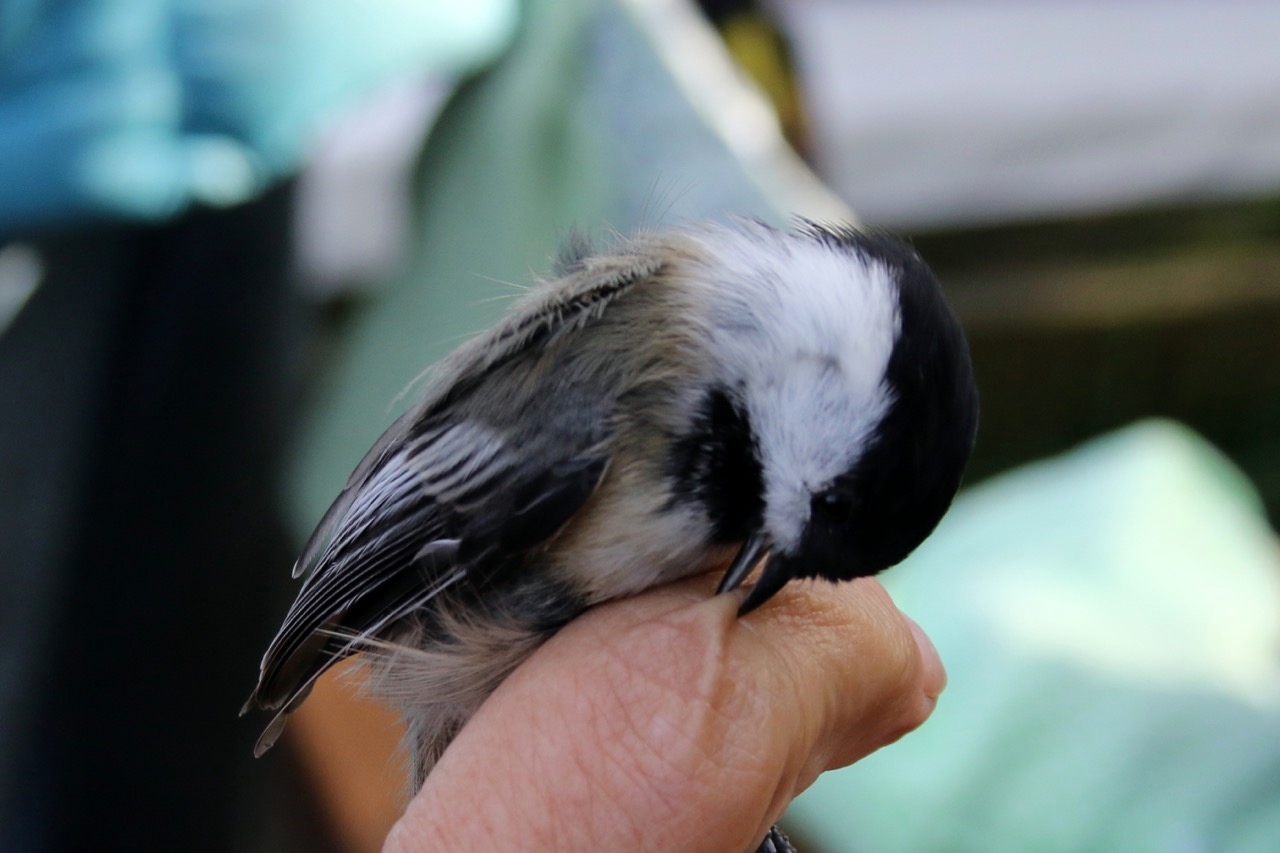
The nets are set up along the trails of the preserve. The perfect site is one with thicket rising on both sides of the trail. The dense vegetation is where the birds hide, and rest and feed. The nets are dark filament, and so fine, that they become almost invisible when one stares through them into the bushes on the other side. That’s what happens to the birds. They decide to fly from one side to the other, do not see the net, and get lightly caught in the mesh. Each bird species seems to react to this differently. The little Yellow Rumped Warblers, which are the most abundant birds at this time of the year, seem to just lay quietly; they don’t struggle and rarely get terribly tangled. Chickadees, on the other hand, are little dynamos. They fuss and fidget and grab the net with their feet. When we start to remove them, they peck mercilessly on our fingers.
Our first trip around the circuit always seems to produce the most birds. They are intent on finding food in the morning after a long cool night. A flock of about a dozen Yellow Rumped Warblers, flying generally together, all landed in the first set of nets. It was a promising start. There were several Chickadees requiring patience and gentle fingers, a Song Sparrow and, the big catch - a Blue Jay. When these big fellows hit the net, they often bounce right out. You have to get to it quickly and prevent escape if you want it on your list for the day.
Each bird is placed in a cotton bag or in compartment in a special box for transport back to our station set up with supplies.
Birds are trapped by fine mist nets.

Chickadees stay busy pecking through the whole process.

Removal from the net requires very patient fingers.

The actual process of banding itself is simple - the placement of an aluminum band on the bird’s leg, that will remain with it for life. It does not hurt; it will not impede, and it is like having a social security number on a bracelet. The bird is identified for life with a unique series of numbers. If it is caught again, or found dead, that number can be traced to the very place and date when it was first banded.
While we have the bird in our hands though, there is so much else to learn. We can determine a lot by looking at the plumage. Some young birds have different markings or coloration than older, adult birds. On the warblers, we look at the brightness of yellow patches and intensity of the markings. We also count the spots on the tail feathers.
Sometimes eye color is important. An adult Downy Woodpecker will have red eyes. We also measure wing length as it can sometimes tell us gender, but not always. To determine age, a small drop of plain water is used to spread the feathers on the bird's head to determine the amount of solid bone present. Like a newborn human, the young birds have a soft spot, a place where the bone in the skull is not closed yet, and it shows as a pink patch of skin, not white bone. We also weigh the birds. The weight is quite variable depending on recent food intake, or recent excretion. But it is all important data. It is a lot to keep in one’s head, but we have books with charts and guidance, and lots of practice.

Tally for the day

At the end of the day we had caught and banded 13 Yellow Rumped Warblers, 7 Chickadees, 2 Blue Jays, 1 Song Sparrow and a Downy Woodpecker. We did have a few escapees.
We also caught a Chickadee that already had a band on it. By looking back into the record book, we found that we banded that little bird on Oct 22, 2014. It was also caught again on November 4, 2015. To be recaptured on Sunday Oct. 22 2017 was quite a record!
For me, sharing the wonder of birds with others, especially children, is as much fun as handling the birds myself. To let a child hold a bird for the first time, to feel its light warmth and energy, to look in its eyes and make contact. It is something that child will hold onto forever.
The Blue Jay is the catch of the day.

This young male Downy Woodpecker shows off his colors.

To be able to hold a small wild birds is something she will likely remember for a long time.


Photographs by Rick Newton.