Showing posts with label Paffard Woods-Stonington. Show all posts

Monday, October 7, 2019

Makeover at Paffard Woods

By Beth Sullivan
The lovely Paffard Woods p off the west side of North Main Street is the first land Avalonia acquired with a big fundraising campaign. That road is often called the Gateway to Stonington because it is the main route from the highway down to the Borough. Preserving the scenic land along the road was a high priority. When Edith Paffard offered to sell the parcel for a bargain sale price, Avalonia applied for grants and then campaigned to get almost $300K in public donations. Thanks to a great team, efficient organization, and the generosity of many people, the 62 acre parcel was acquired in August of 2003. Since that time it has remained one of Avalonia’s most beloved and well-used preserves with a wide variety of habitats, vegetation, and topography. Trails go around granite ledge outcrops and glacial erratics, wind through woodlands, and border the Sylvia’s Pond Brook. Central wetlands drain into the brook, and ultimately at the southernmost tip, the preserve is salt marsh.

It started with bridges

This rustic old log bridge was beginning to rot.

New planks were added to this old bridge

Two benches were made from one of the old logs.

Originally, the first stewards created some beautiful and unique bridges. One is a rocky crossing where you can hear the brook babble and tumble below your feet. Another bridge was created from a huge, impressive log, cut lengthwise and set over a stream. Other bridges were established in other places. Over the ensuing years, with high foot traffic, wear and tear, and also recent wetter than average conditions, we noted that several of the wetland crossings were becoming muddy, and the bridges themselves were breaking down. Much to our dismay, we discovered that the huge supports under the log bridge were no longer stable, and there was rot occurring. People love that bridge.
Thanks to the generosity of the original donors, there was a nice stewardship fund available for use on the preserve, so we knew we could get materials. But we never seem to have enough strong and willing bodies to tackle big projects. Luck came our way when our connection with the Mystic Aquarium allowed us to engage volunteers from Dominion Energy. Now we had the bodies.
Two of our town stewards, Jim F and John C, got their heads together to plan out the projects. A new bridge was designed to replace the log bridge, and a plan was made to actually lift and move another bridge to a more solid location, out of the mud. Another bridge had surface planks to be replaced.
On a beautiful September day, 22 employees of all ranks gathered at Paffard Woods at 7:30 am. Our stewards met them, as did MaryEllen, our Aquarium connection, and work commenced. Materials and equipment were unloaded and set up. It was as good as a shop in the parking lot. Order and organization was the key. Teams split up, and in a relatively short time, a great deal was accomplished. The log bridge was removed, but to retain the memory of the original design, one log was cut in two to create benches, set on stones, on either end of the new bridge. They are perfect. The other span was moved and placed in a much better spot, and the wood planks were replaced on the third bridge. And still there was a lot of time left.
This bridge was lifted out of the mud and re-positioned on solid stream banks.

A rock and a hard place

So a group decided to tackle a big rock that was sticking up in the middle of the driveway entrance. It has been a danger and nuisance for quite a while now, so the plan was to dig it out and fix it once and for all. What no one knew, was that the rock was a boulder, seemed to have its roots firmly in the ground and no amount of maneuvering and leveraging would budge it. Now we were stuck with a big hole, with a big rock, in the exit, and no one could get in or out.
Several of us put our heads together and tried a few local farmers to see if their equipment would be useful. No luck. In a last desperate brainstorm, we called a local contractor who was going to do some mowing work for us. He just happened to be in town, with his big excavator and trailer, and inside of one hour, JP Moore arrived with his equipment. It was impressive. He unloaded, and the driver manipulated that machine as deftly as fingers, picked up that rock in an instant and set it aside as if it was a pebble. While he was at it, he removed a few other troublesome rocks, backfilled the big hole, widened the entry way to make an easier access, and just happened to have some perfect small stone to resurface that part of the driveway. Talk about a lucky angel. Turns out JP also had worked at Dominion Energy and knew several of the work team. It was a happy reunion of sorts.
By the end of the day, bridges were all fixed with just a few details left to complete, piles of invasives had been cut or pulled from along the stream and trail, and unexpectedly we had a total rehab of the entry way to the preserve.
We owe many thanks to the original donors, our Avalonia carpenters, our friends at Mystic Aquarium, Dominion Energy and JP Moore excavating.
Go take a hike and enjoy the upgrades.
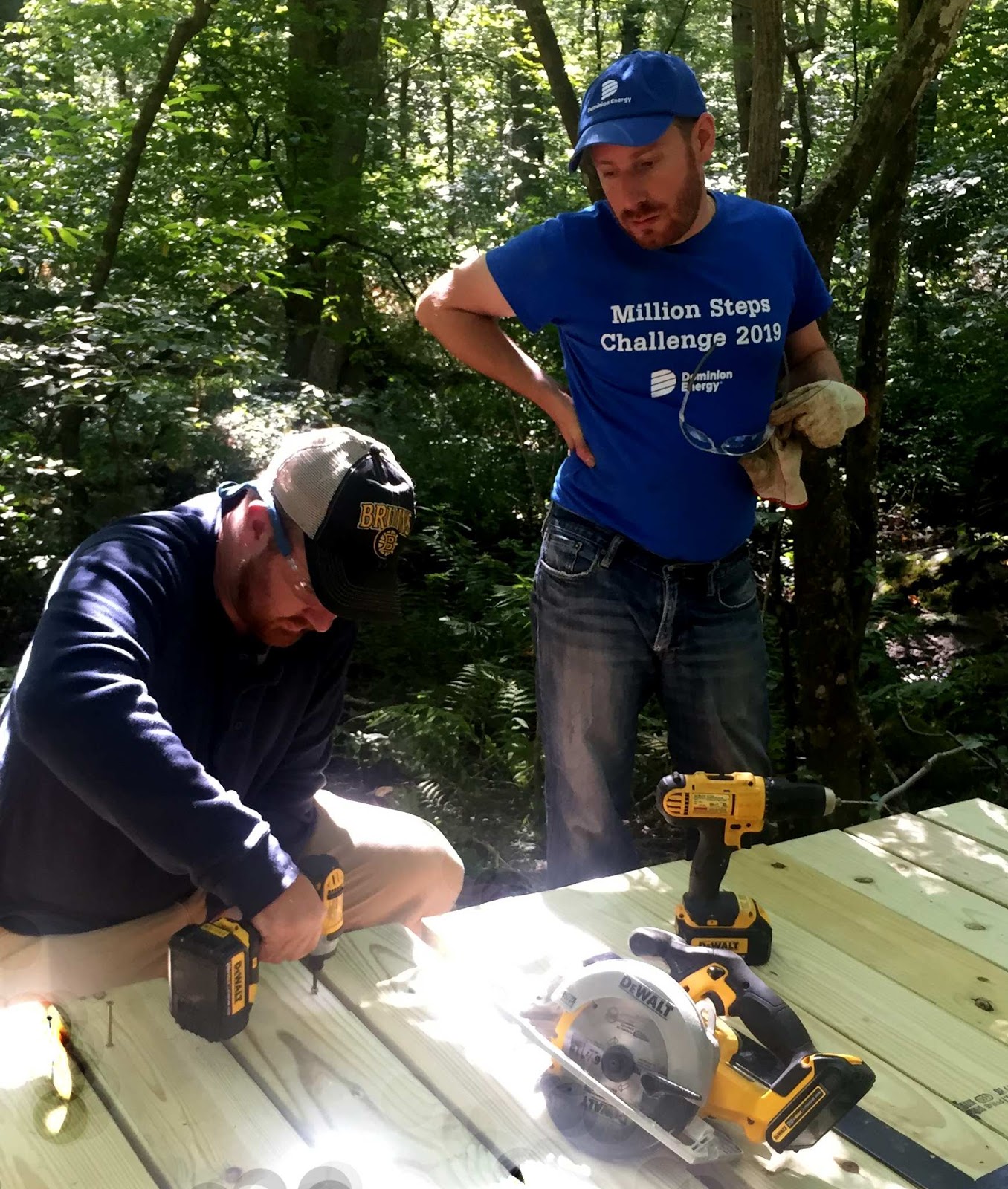
Volunteers from Dominion work on this new bridge.

This rock was a lot bigger than expected.

But the right equipment made quick work of the rock.


Photographs by Beth Sullivan.

Monday, April 29, 2019

Walking in the wet woods

By Beth Sullivan
It is spring, and we all know about April showers…but these downpours! They are making life a little difficult for some of us, but excellent for others. The drought is over; the water table is high; amphibians are very happy.
Some projects need to be delayed due to high water and very muddy conditions. The Hoffman Forest restoration project is still on hold until conditions can dry out more. Mud is terrible on heavy machinery. There are plans to do trail work and bridge repair on several preserves. Our second work party on Pequotsepos Brook was delayed, due to more down pours and flooding. Paffard Woods trails are also due for maintenance and bridge rebuilding, but with water so high it is nearly impossible. However, a walk in the spring wet woods is quite wonderful. So we put aside the projects and just enjoy the season as it is.
Avalonia preserves many beautiful wetlands which are productive and critical habitats. Many protect drinking water supplies. Wetlands also protect numerous species of special concern. In the not too distant past, wetlands were allowed to be filled and developed. Now they are protected and cherished.
Skunk cabbage flowers have been siting inconspicuously for months

Some projects need to wait for the water to subside.
 

In Paffard Woods

On a recent walk through Paffard Woods, we had time to enjoy this lovely area with rocks and ridges and a central beautiful brook. Generations ago the brook was named Stony Brook and the water flowed freely from farther north in town, all the way to Quanaduck Cove and into the Stonington Harbor. We have some old maps that show the passage of the waters. Then a dam was built to create what is known as Sylvia’s Pond. The main flow over the dam took a more westward route, and kept the name Stony Brook. It ultimately ends up in Stonington Harbor too, but in a different area. A smaller outflow follows the old stream bed and is mostly referred to as Sylvia’s Pond Brook. This is the lovely waterway flowing through Paffard Woods Preserve.
The wetlands in here are pretty typical for this area. They green up earliest in the spring. For months the skunk cabbage flowers have been inconspicuously present close to the ground. Those of us who know and love the plant, search for it every early spring. Now the flowers are dwarfed by their very conspicuous big green leaves that spread throughout the wetlands. Alongside them are the false hellebore plants, looking a bit like short corn stalks. Later, those that are in sunnier areas will have interesting flowers. My favorites are the marsh marigolds, or cowslips, that are glowing bright yellow right now. Along-side them are lovely and delicate purple violets. Mother Nature knew about complementary colors putting those two together.
We are also very excited to see several large areas covered with the speckled leaves of the trout lily, also called dog-toothed violet. These are very ephemeral wildflowers, their bloom doesn’t last long, and even their leaves die back after a few months. These and many other woodland wildflowers take advantage of the open canopy to enjoy the sunshine before the trees themselves leaf out. Spicebush is a shrub that is also taking advantage of the early spring sun, to create a lacey haze of soft yellow flowers at a higher level off the ground.
In this old map, Stony Brook runs its original course, before Sylvia's Pond was created. (Map of unknown providence.)

The best spring combination- marsh marigolds, purple violets, and big green skunk cabbage leaves.

Early Invasives

The only sobering fact about observing these woodlands now, is that it is obvious that the invasive plants are the very first to leaf out, green up and take over. It is their successful strategy for bullying their way to take over space in an area. Here in Paffard woods, the greenery now is deceiving. Much of the mass of delicate foliage is actually invasive Japanese Barberry. This plant is terrible: impossible to walk through, impossible to manage, and a known habitat for ticks.
Enjoy a walk along a trail in the wild, wet woodlands. Look for the delicate flowers; look for the hardy ones too. But stay out of the barberry. As we have all heard before: please take only photos and do not pick the flowers. That’s what a conservation mission is all about: the next generation of people and flowers.
The fleeting beauty of a trout lily.

Vernal wetlands are filled, and the yellow haze is created by the spicebush in bloom.

All the green in this photo is foliage of Japanese Barberry.

False Hellebore flowers are often overlooked but are quite pretty.


Photographs by Beth Sullivan, unless otherwise indicated.

Monday, April 9, 2018

Introduction to some of the Students at Connecticut College

 As promised, here we meet one of the Connecticut College GNCE students who, for his project, will be writing the blog for a while.   Part of Avalonia's mission is to communicate the value of our irreplaceable resources and what better way to do that than to have a student learn the value and then communicate it them self.   We will enjoy a youthful view on things for a while. Hopefully when it is my time to start writing again, I can report that spring has indeed arrived and there will be no more grousing about bad weather, cold, and storms. We all look forward to our spring stewardship efforts getting us back to the nature we love.   Beth

By Alan Lau

For the last six years Avalonia has been collaborating with Connecticut College students in the Goodwin-Niering Center for the Environment (GNCE). Approximately two dozen students learn about Avalonia, its achievements, and just how hard it is to keep a non-profit, non-political, tax-exempt organization running.

My name is Alan Lau, one of the sophomores in GNCE, and I will be taking over the Blog for a few weeks in order to update you all on the projects my peers are tackling. This collaboration between GNCE and Avalonia has truly been a great privilege for students that come from inner cities like myself. Before joining GNCE and learning about Avalonia, I couldn’t even begin to imagine how much work it took to manage a land trust. Then our good friend Beth came along and briefed us on just how complex the organization is. Officials must deal with governance, membership, fund raising, and a multitude of other aspects which all have a profound effect on the organization as a whole.

The first project is called the “Stop Sucking” campaign in which my fellow peers Anna Laprise and Avatar Simpson are pushing for the removal of plastic straws, by educating the public on the dangerous effects that plastic straws have on our planet and promoting alternatives that reduce plastic straw consumption. There are simple solutions to this problem, one of which is simply having reusable stainless steel straws, which can be cleaned and reused multiple times. Other solutions involve bamboo or paper straws which are much more biodegradable and recyclable than plastic. The problem with plastic straws lies in the plastic material which does not biodegrade but breaks down into small pieces of plastic that get consumed by animals and stay in the earth for hundreds of years. In addition to this, even if the plastic is recycled, only a very small amount of the plastic will actually be reusable until it goes back to a landfill. This problem is globally significant . The EU is pushing for a multitude of single-use plastic products like straws to be removed from 27 member states by the year 2030.
Here we have Avatar Simpson ‘20 and Anna Laprise ‘20. Their “Stop Sucking” campaign has already begun with local coffee shops on campus. One shop is beginning to tally how many plastic straws are being used per day and even adding stainless steel straws.


The next project is conducted by Jonathan Monderer. On April 7th, from 12-3pm, I and 30 other volunteers from Connecticut College went to Paffard Woods in Stonington, CT to help pull Japanese barberry plants that have invaded the stream line in the woodlands. At this time of year, the pulling is easier than other times due to wet soil. Some clipping was done but pulling was the best way to get rid of the roots. Once the plants were pulled, we used garden carts to bring the plants up to the parking lot to make piles for later removal. Getting rid of invasive plants is crucial to the survival of native plants around the area because they disrupt the food chain since the invasive plants do not have the natural predators they would have in their native lands.
Here we have Jonathan Monderer ‘20. He led the Work day at Avalonia’s site in Paffard Woods in Stonington, CT. Jonathan is on the Connecticut College’s Ultimate Frisbee Club where he recruited more than a dozen students to help with the work day on April 7. 


In all, we GNCE students are enthusiastic about our projects. We are ready to reach out to our communities to educate them on the land management, land preservation, and spreading the knowledge which corresponds to Avalonia’s mission of continuing to protect the threatened and declining habitats by conserving its natural resources. 


Paffard Woods is the location where Jonathan's work day took place on April 7.

A beautiful bridge in the Paffard Woods Nature preserve, crosses the stream where the Barberry grows.


Photographs by Beth Sullivan and  Alan Lau.

Monday, January 16, 2017

Winter (?) Woods

by Beth Sullivan
January has the reputation for being a little fickle with a tendency to have a “January Thaw” somewhere near the end. Lately Mother Nature’s mood swings have been a bit more drastic, and all happening in a week’s time.
Last weekend we were snowed in; just shy of a foot of snow fell here, with frigid temperatures. The snow was beautiful, light and fluffy and the woods were cloaked with a purity and crispness that we hadn’t seen yet this season. Judging from the tracks on several of our preserves, a number of people braved the cold to don snow shoes or cross-county skis. I was fine with just boots.
With snow on the ground, the brook was just a series of dark holes in the white.

Visiting Paffard Woods

Paffard Woods is beautiful any time of year. Always something new to see. Because it is close to home, it is a favorite to drop into, to check the trails, look at the water levels in the brook, and, unfortunately, to do a necessary trash pick-up in the parking lot.
The beige leaves of the beech trees remain in contrast to the snow, and rustle in the wind.

With the fresh snow, the trails and woodlands took on a lovely soft rounded and bright look. Thanks to some earlier rain, there was some water in the brook, and the open pockets looked dark and made for pretty contrasts. In some places we could still hear the little gurgle of the brook, not fully frozen, under the snow and between the rocks. It was easy to see where squirrels had dropped into the snow and possibly tried to find previously buried acorns. There were some interesting prints, where birds had landed on the snow, only to find it was probably deeper than expected, and their wings left prints as they lifted themselves out. All in all a cold yet quite lovely hike in the woods.
Something popped out to find a snack.

The soft impression of a bird's wing.

Fast forward just a couple of days; the temperatures hit the upper 50’s, there was heavy rain, and literally overnight the snow disappeared. The warmth seemed to stir more squirrel activity as we saw them foraging through the leaves, but no prints this time. We saw a few moths and hoped they were not the dreaded Winter Moths still out and looking for reproductive opportunities. The feel of the woods was like April. There was almost a humidity to it. The streams were running quite full, and we undammed a few areas where leaves and debris had blocked the flow and created flooding around the bridges. (Playing in running water is fun anytime of year as far as I am concerned.) The water flowing under and through the stone bridge on the middle trail was so beautifully noisy, we just had to stop and listen and spied some evergreen Christmas fern still looking fresh. We noted skunk cabbages up in the wetlands; the moss was an exuberant green on the rocks and ledges, and the lichens were all soft and rubbery from the abundant moisture.
With rain and snow melt, flooding needed to be relieved.

After the thaw, the moss and lichen were refreshed.

The brook is refilled, and the mosses and ferns tease us with their emerald color.

Not Spring yet

I know we are in for more cold. As much as I enjoy the respite and warmth, I know the temperature swings are not good for many plants and animals. We do not want things emerging from hibernation, teased by warmth and thawed wetlands. We do not want to see flower buds begin to swell, all only to be blasted back by the cold we know will come. We do need things to stay in sync. So much depends on it. But it sure is fun to see so much variation in a short time, in a familiar place.


Photographs by Beth Sullivan.

Thursday, May 15, 2014

Stone walls

Walking the trails of Avalonia preserves we see stone walls everywhere. The old stone walls are so common they seem to blend into the beauty we see and can almost be lost as distinct features. 

 Did you ever wonder why there are so many stone walls in southeastern Connecticut?


This wall on the Paffard Woods Preserve gets the once over by the Connecticut College Track and Field Team during a recent work party.

Tonight (Thursday, May 15) author Robert Thorson  will explain all during a lecture at the La Grua Center in Stonington. The program starts at 6 pm.

Find out more here.

Monday, April 7, 2014

Building a better brush pile

By Beth Sullivan
The problem with a partial “ beauty makeover” is that the untouched parts really look awful by comparison!! Over the past weeks you read of work parties giving a face lift to the stone walls along Paffard Woods. They look great. But it made us realize the rest of the area needed a face lift too! There was still a lot of post Hurricane Sandy debris, drying and browning all around the parking area. A couple of us decided to continue the make over before things got growing.
This preserve is in a place of high visibility, passed by residents and visitors to our town as they travel North Main Street. It is beloved by hikers of all ages as it has a great variety of habitats and scenery. There are geocaches and fairy houses. Wood frogs and Peepers are making their chorus now. Pine groves line the road on the eastern edge; the trails lead down to a beautiful clear and often swift running stream, Stony Brook. Views of rocky ledges, small caves, large beech trees, glacial erratic boulders and vernal pools meet the eye around each corner. The loop trails follow stone walls with old Oak “Nooning trees”, allow places to stop along the brook and then pass over interesting stream crossings before leading back up and around to a field edge and back along the pines to the entrance and parking area.
Stony Brook in Paffard Woods Preserve.
Beech trees and rock ledges are common features in the Woods.
Sadly it is often a “night time” meeting spot and dumping area so we were faced with an odd assortment of litter and debris. Pretty awful. We decided to dismantle the huge brush pile that was thrown together haphazardly after the storm, in order to get to bigger pieces that needed better cutting to be more manageable. What to do with it all? Well, we made another brush pile! But this time it was created in a way to encourage wildlife. Yes, there is a way to build a better pile!
Dumped garden waste detracts from the beauty of these woodlands.
Starting with the largest pieces, small logs, we laid them down as a base, parallel to each other with at least 10-12 inches between them. The next layer was slightly smaller pieces, but still solid, and laid in a cross hatch manner over the base. The next layer above that was more or less placed the same as the first. This produced great nooks and crannies, holes and openings, near the ground, that tunneling mammals so love. Mice, voles, chipmunks and rabbits will nest inside the protected base areas. After those layers, things get a little less organized and brush is smaller and lain atop the base. It can be angled up from the sides, but the smaller branches on the top then make a denser cover for birds to fly into. Some birds, like wrens, will nest in the piles, but they are essential cover for many species of fledglings. We ended up with quite the wildlife resort!
The base layer should be the largest logs.
The second layer should be cross hatched over the first.
The third layer should make another cross hatch.
Top with brush, piled high for shelter.
There is still more to be done. Some really big pine trunks need to be cut and moved. A work party will follow soon. It still looks pretty brown and broken in places, but soon the green season will soften the edges and cover the winter gray.
There's always more to do, consider helping at the next work party.
Look at the brush pile for signs of life and think of it as a safe haven. Children enjoy making little Fairy houses in the woods. Avalonia Volunteers think BIG…and make more brush piles for wildlife. Get your kids to help you do the same in your yard or wood lot!

Photographs by Beth Sullivan.

Monday, March 31, 2014

Putting more field in Track and Field


By Marina Stuart and Cian Fields
Connecticut College

 Every March, the Track and Field team at Connecticut College does two community service days. In recent years they have been at local farms or recycling plants, any place that could put fifty odd people to work. This year, they worked at two preserves owned by Avalonia Land Conservancy. 
The idea was started when the Goodwin-Niering Center for the Environment (GNCE) at Connecticut College teamed up with Avalonia for the second year, to give the new sophomores of GNCE projects to help them understand land conservancy and stewardship. One of the projects was to find ways and strategies to expand Avalonia’s member base and especially to reach out to younger people in the community.
After discussing details of times and places and numbers, the track and field team and Avalonia decided that there would be two work days: one at Paffard Woods Preserve and one at Dodge Paddock. Each day had the same main goals: remove brush and invasive plants and do any other work that needed to be done on the site.
Students from the Connecticut College Track and Field team work to clear the walls of the Paffard Woods Preserve.

The first work day was Tuesday March 18th, and 25 members of the team and one coach made their way over from Conn to the Paffard Woods Preserve along North Main street in Stonington. The team was met by Beth, Binti, and Anne from Avaloinia, and after distributing tools we set out. The main point of Tuesday’s work day was to clear the stone wall that lines the preserve along road. Parts of it had been cleared earlier, but huge sections were covered with multi flora rose bush, poison ivy, bittersweet and other vines.

There is a wall!

Everyone divided into small groups of four or five people and spaced out along the wall. We worked hard for about two hours, clearing off the majority of vines and plants from the rock wall. Even though it was cold and cloudy, the team members still enjoyed themselves. One member said that this work was much more rewarding than the community service projects done in the past, because we could actually see the fruits of our labors and pulling off weeds was fun and cathartic.
Twenty-five team members helped clear the wall at Paffard Woods.

On Thursday, which turned out to be a little warmer and sunnier, a new group of athletes traveled into Stonington to Dodge Paddock. With the waves crashing, everyone set to work clearing off the large, historic, stone wall in the back of Dodge. There were huge stalks of oriental bittersweet and multi flora rose everywhere but the team set to work with their clippers and loppers, pulling down vines from the rock wall. Some of the stalks of Ailanthus trees were so thick at the bottom we had to take a hand saw to them!
The north wall of Dodge Paddock after the Track and Field team cleared it.

We also removed large rocks and branches from the ground to clear the way for a mower. We set to work removing stumps, which was great fun for all of us and very rewarding in the end . There is nothing like the feeling of yanking out a stump and seeing all the roots that go with it, dangling in your hand. After the wall was cleared we set to work trimming back the multi-flora rose and also removing debris and vines from the lone tree that stands in the corner of the meadow. After another two hour period Dodge was cleared out, and we think the Borough of Stonington was a little surprised at all the logs and braches we carried out and piled up in the parking lot. Overall the work days were hugely successful and hopefully the start of a new partnership between the Connecticut College track and field team and Avalonia!
The north wall, looking toward the water.

Monday, January 20, 2014

Where does the Fox go?

By Beth Sullivan
We all have been through some pretty brutally cold weather recently and some pretty erratic temperature swings. Can you imagine what a toll it takes on our resident wildlife?
Take a winter walk and, if you are really lucky, find a child to take with you. Think like an animal in winter.
Any nature preserve or bit of woodland or backyard will work, but try Paffard Woods off North Main Street in Stonington.
We tend to think of mammals in winter as hibernators, but in reality most of them are not. Locally the Woodchuck or Groundhog is our deepest sleeper. In the late fall they fatten up and retreat into deep burrows, far below the cold surface. Their metabolism slows, and they will not emerge until February or March. Woodchucks can be found in woodlands, but more usually along farm fields and open lands, their burrows marked by mounds of earth.

Red Fox
Most of our other resident mammals are only semi-hibernators. They may be inactive for long periods of extreme cold and bad weather, but will rouse themselves and move about during the winter months.
The Red Fox will adopt a Woodchuck burrow in a more open area and preferably near water. They pair up in winter and dig or expand a den as part of the bonding process. You may come upon a woodchuck hole with what appears to be a lot of new gravel at the entrance. At this time of year, Woodchucks are sleeping. It is the Red Fox doing the digging. You can often sniff out a fox den too; they have an odor similar to skunk which lingers near their abode. They hunt mice and small rodents and have an uncanny ability to find them deep beneath snow. Have that child you are with look for mice tunnels, look for foot prints in the snow, and look for holes that look active and smell skunky. That’s where the Fox goes!
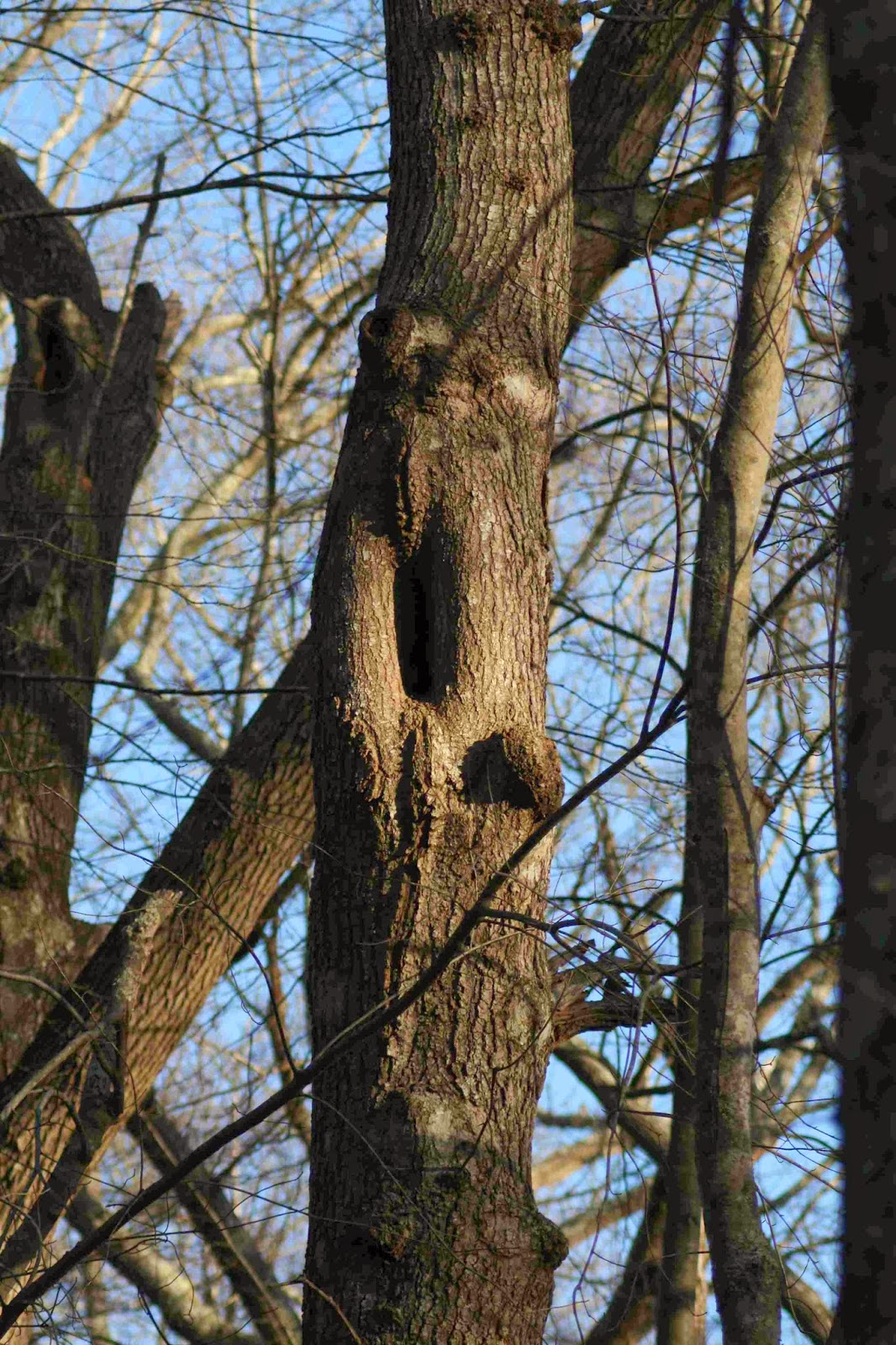
In the woods, look up and down for holes: holes up in trees, at the base of trees, in crevices, under rocks and by stone walls. Little ones and big ones. Just imagine what might be in them.
Large hollows in trees are good for many mammals.
The Gray Fox is our true native fox, and they tend to like the rocky woods. Look for holes at the bases of the ledges and between boulders. With the brook nearby, that would be a perfect place for a den.
The Gray Fox likes a rocky den.
Opossums and Skunks are usually considered nocturnal, but during the winter they make use of the warmth of daytime to forage. They will hole up in a tree cavity or hollow log, often in family groups. It’s warmer that way.

Gray Squirrel.
Holes at the base of trees often lead to tunnels higher up in the core of the tree. Hollowed out by ants, smaller creatures, like Chipmunks, will stash their nuts and seeds and remain sheltered inside. Squirrels will make use of holes, but also make big fluffy, leafy nests high in the branches and may rotate their lodgings as the mood strikes them.
A Squirrel's leafy nest.

Chipmunks will nest in stone walls.
Hickory nut shells at the base of this tree hint that someone is inside.
Raccoons will be active irregularly during the winter. When it is truly cold and stormy, they will seek refuge usually high in a tree, a hollow or snag. You might even find a raccoon peering out at you from a high safe place as you take a winter walk, but you have to be looking!
Small holes for squirrels and even some birds are found high up in trees.
Get that child to stop and look, all around. Find the holes high up and low down. Look in the ledges, wall, trees and stumps. Think like an animal and see where he or she might choose to spend a cold winter day.

Photographs by Rick Newton and Beth Sullivan.