Showing posts with label milkweed. Show all posts

Monday, August 3, 2020

Life in the Milkweed patch

By Beth Sullivan

Anyone who has spent time in fields , meadows, or wetlands is very likely to be familiar with at least one species of milkweed (Asclepias). Some of us, who spend a lot of time in those habitats are pretty familiar with several kinds of milkweed and many of the creatures that associate with it. A patch of common milkweed (Asclepias syriaca) is quite robust and can form large colonies as its roots spread and stems multiply. Swamp milkweed (A. incarnata) is a bit more delicate, a uniform pink with slightly fuzzy leaves. As its name suggests, it prefers wetter soils. Butterfly weed (A. tuberosa) is a shorter bushier plant with bright orange flowers and favors sunny, drier sites. As a species, milkweed is known for its milky sap which is actually toxic to most things. We would not die, but would likely be quite sick if we ate a salad of milkweed sprouts or leaves, as the sap contains chemical compounds which can be fatal to smaller creatures. Most children know the story of how the monarch butterfly is poisonous to birds, and that this protection comes from the milkweed plant. The adult butterfly gathers nectar from many plants, but lays its eggs only on milkweed. When the eggs hatch, the larvae begin to feed on the leaves and ingest the toxins. This does not hurt them, but actually makes them toxic in turn. Very few birds will attempt to eat the fat, juicy monarch caterpillars, and when they emerge from their chrysalis, the adult butterfly is toxic as well. The bright orange and black markings are known to be warning signals to birds or other predators that there is a danger present. Other insects also display black and orange colorations and in turn are protected by mimicking the monarch.
A monarch will take nectar from many flowers but the swamp milkweed is favored for laying her eggs.

Beautiful common milkweed

Only one egg is deposited under a leaf, ensuring the monarch caterpillar an immediate food source.

 Not just for butterflies 

But it is not only monarchs that take nourishment and shelter in the milkweeds; many species of butterflies can be found just by observing one patch of plants. First, inspect the flowers: they are really quite beautiful in shape and form, and they can be very fragrant when they first bloom . Bees and wasps of all kinds are attracted to the beautiful flowers and abundant nectar as well. Inspect the leaves. Tell-tale signs of a caterpillar at work are the chewing patterns and holes in the leaves. Monarch caterpillars seem to make small holes right in the leaf as they get going. Other insects will nibble edges or the tips as instead. They also excrete a lot of waste, called frass, as they eat and digest. A real good sign of a caterpillar. Be on the look-out for other insects as well. Aphids of several colors are frequently found covering parts of the stems. They suck plant juices and excrete a sweet “honeydew” liquid that attracts ants. Ants are frequent climbers of milkweed stems as they tend to their aphid farm. Another very common find is the red milkweed beetle. They look like an elongated ladybug with extra long antennae. They like being up near the tips of the plant and are quick to drop to the ground when disturbed. If you feel like being brave ( they don’t bite), pick one of them up between your fingers and hold up to your ear-they make a squeaky-clicky noise. There are leafhoppers, snow crickets, and numerous kinds of flies that visit the milkweeds. One non-insect that I have noticed more recently is a snail, a small air breathing land snail, part of the amber snail family; these are likely European. I have discovered quite a number of them cruising , if you can call it that, along the leaves and stems of milkweed. I don’t remember them from my childhood.
Aphid colonies suck on the plant's juices then secrete a sweet liquid that in turn attracts ants.

As a full-sized caterpillar eats, it leaves behind tell-tale frass.

The red milkweed beetle is easy to identify with its bright color and black spots.

 Milkweed abounds 

The Knox Preserve and Preston Nature Preserve are two of the best places to easily find all kinds of milkweed along the trails. While I was moving through the big patch at Knox, I managed to trip into a well-disguised woodchuck hole, and as I tumbled awkwardly, I scared a rabbit out of hiding. With attention to the little things, you may be surprised at the variety of wildlife you will find associated with milkweeds.
Air breathing amber snails are now common on milkweed plants.

Can't beat the beauty of a red-banded leaf hopper.

Photographs by Beth Sullivan.

Monday, August 15, 2016

Milkweed season

By Beth Sullivan
It’s been a bit too hot to really enjoy walking through bright sunny fields, but they are busy and full of life.
The flower of the Common Milkweed is really very pretty, and welcomes great numbers of insect pollinators.

The Goldenrods, Joe-Pye weeds, and IronWeeds are just beginning to bloom adding color to the white of Queen Anne’s Lace and later season greens . The grasses add their own fine textures with seed heads. As the fields become havens for pollinators-bees of all kinds, butterflies, flies, moths and numerous bugs and beetles-the birds are enjoying a feast, flying and foraging over the meadows catching their food on the wing. It is a joy to watch the Swallows and Martins at Knox preserve, swooping and soaring over the fields.
A wetland full of Swamp Milkweed is a beautiful haven for Monarch Butterflies.

Many types of Milkweed

Included in these fields are the flowers of the Milkweeds. Its family has many members. The bright orange Butterfly Milkweed has a pretty long flowering season; there may be some still visible in the fields but most have gone to thin pods. The same is true of the Common Milkweed with its looser pinkish flowers and plump warty pods. Right now the Swamp Milkweed is in full flower, bright pink and with noticeably fuzzier stems and leaves.
Orange Butterfly Milkweed is a favorite. 

The Swamp Milkweed is supporting a full-sized caterpillar, and a population of Aphids.

What they all have in common is their importance to Monarch butterflies. The flowers are attractive to many species, and those bees and flies also contribute to pollination. For the Monarch though, these plants are essential to their life cycle. All members of the Asclepias genus contain a chemical, a cardiac glycoside, that is considered toxic to most other insects, birds and people. We would not do well to add Milkweed leaves into a wild salad. But not only do the Monarch caterpillars eat the leaves, and survive, they are protected by that chemical as it is stored in their bodies, and predators become sickened if the caterpillar is eaten. The chemical protection continues into the adult Monarch, and over time, birds have learned not to eat the “Black and Orange” butterfly.
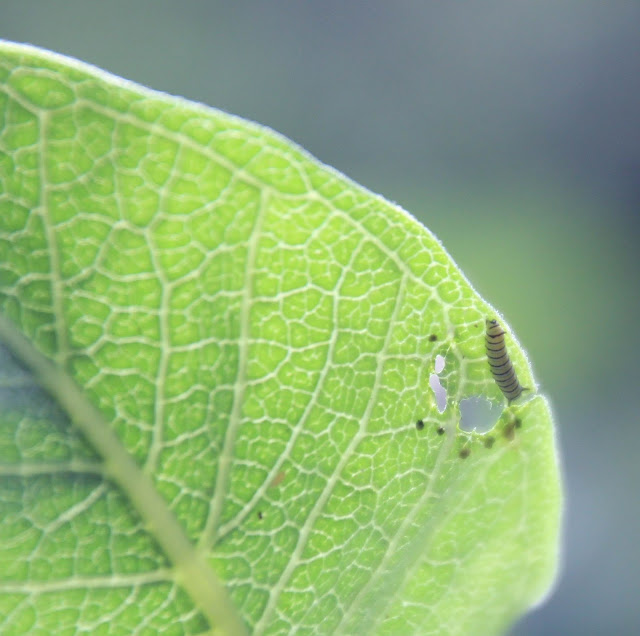
Immediately after hatching, this caterpillar begins to eat and consumes the protective chemical in the Milkweed leaf.

The Monarchs have suffered greatly over the last decade, and their numbers have dropped dangerously. In part it is due to their wintering habitat in Mexico being destroyed. In part it is due to decreased availability of Milkweed here in the US. So, in an effort to support a much beloved butterfly, we are encouraging Milkweed to become established in whatever areas are suitable.

Not just for Monarch Butterflies

It has also been interesting to discover other creatures dependent on the Milkweed. One is a Milkweed Beetle, also colored red with black dots. They live in and around the Milkweed’s main stem and don’t seem to do a lot of damage. Aphids often colonize the Swamp Milkweed, and their sheer numbers, sucking sap from the bases of flowers, often does cause a decrease in seed production. There is also a fuzzy caterpillar, a Milkweed Tussock moth caterpillar which is also colored orange and black. When they attack a plant, they devour it completely, and I have witnessed them eating leaves that contain monarch eggs and small caterpillars. Another surprise finding was that there is a species of snail that seems to favor milkweed leaves. I can’t be sure if they are feeding on the leaves, or something else on the leaves, but we have seen this in several instances.
The Milkweed Beetle is another orange and black insect closely associated with this plant.

A small land snail is often found on Milkweed leaves.

Take some time to walk through a meadow with Milkweed. Think of all the associated wildlife with just this one special plant. Maybe you can find a place for a patch in your own yard.
Mating Monarchs are a sign of hope for their future.


Photographs by Beth Sullivan.