Showing posts with label native plants. Show all posts

Monday, December 24, 2018

Reds and greens in the winter woods

By Beth Sullivan

We are at the darkest days of the year. The woods can look pretty drab and it even makes me wish for just a bit of snow to change the scene. But take a walk and look closely, you will find some welcome color, red and green, to greet you for the holidays.
We all know our Pines, Spruce, Firs, and Cedars, the bigger evergreens of the woodlands. They provide great protection for birds and other small creatures when the winter winds blow and snows fall. Their cones hold nutritious seeds, high in fat and protein that the wildlife need to help them through the cold season. 

Some different evergreens

Look a little lower, the shrub layer in many of our woodlands is dominated in places by our State Flower: Mountain Laurel. Drive along many of our roads where the scenery is rocky and rough, you will welcome the sight of gnarled branches and leathery green leaves of this lovely shrub. While it doesn’t provide a food supply, the usefulness as nesting sites for forest birds is often revealed in winter.
In some of the more remote wetlands areas, our native Rhododendron (R. maximum) will stand out, green against the brown. During the severe cold, you can note that the leaves droop downward and curl into tubes. This is the plants’ adaptation to protect the leaf surface from cold and dehydration in the dry winter air. 


Rhododendron leaves droop and curl in winter.

Bright winter reds

Native hollies provide winter interest. Our American holly, (Ilex opaca) the familiar Christmas decoration, has spikes on the leaves to deter deer but the berries are feasted upon by many birds, now and through the winter, as long as they last. Robins, Thrushes, and Bluebirds in particular will find a bush and claim it.
Native winter holy

Our other native holly, Winterberry (Ilex verticillata)is deciduous, but its berries glow red on bare branches during this season. These berries often do not fully ripen until they have been cold for a long time, then they ferment, and the birds love them. This is true of many berries that remain on the bush through the winter: Viburnum and crab apple in particular. Those birds know how to wait until the vintage is perfect.

Winterberry with Mantis egg case.

Mosses for the season

Club Mosses ( Lycopodium sp.) such as Princess Pine and Ground Cedar ( They have multiple common names) will populate the ground in patches. Years ago they were harvested irresponsibly for Christmas decorations and the populations were nearly decimated. Garden Clubs have protected the species by refusing to pick it, or sell decorations using the club mosses.
Ground Cedar is a clubmoss.

Emerald green cushion moss brightens the landscape.
Many other species of moss seem to become more intensely emerald at this time of year. Sphagnum moss, which holds the water in the wetlands, is more softly colored, but look closely at the structure of each plant: miniature Christmas trees.
There are a few evergreen plants, still holding leaves: Christmas Fern for one, each ‘leaflet’ on a frond has a “toe” creating a “stocking”. Partridgeberry is a sweet vining plan with delicate evergreen leaves. The occasional red berry remains on the plant as an invitation to a ‘Partridge’ who may favor the berries. Sadly our native partridge or quail, the Bobwhite is considered extirpated from Connecticut. Only to be remembered in Christmas song, being in a Pear Tree.
On the Christmas Fern, each leaflet has a stocking toe.

Partridge Berry.

Happy Holidays to all and enjoy the winter woods. 

Photographs by Beth Sullivan.

Monday, January 5, 2015

New Year on Avalonia Trails

By Beth Sullivan
By the time you are reading this, some of us will already have broken our resolutions: to always eat heathy, exercise every day, lose weight…..you know. But I will share one of my resolutions: to walk all of Avalonia’s trailed properties over the next year so that I can be familiar with them, observe wildlife and plant life, take photographs, and do blog entries to share.
Identify an evergreen plant.

Really my goal is more for others than for myself. I am truly dedicated to getting people, especially kids, outside!

Walk, Photograph, Question

As we in Avalonia are stretching to find new ways to educate people, nourish the next generation of conservationists, and train those who will come after us, we have to get those young people out there on the trails, getting curious, observing, and interacting with nature. Most people do not need real formal lessons, some would like some hand holding the first time they roll a log or follow a trail. But really what you need is a sense of adventure and curiosity. That is what got me hooked. I want to know what is beyond the next hill, up that tree, in the brook, under the log and in the rocky cave. I want to know what bird I have spotted or what a particular plant is. Sometimes I wish for a pack animal to haul my books, cameras, binoculars, hand lenses,…
A Woodpecker's hole.

Explore a small stream.

But here’s my secret and one that I challenge you to try: Get those cell phone and smart phone cameras and put them to use! No texting or emailing or facebooking and tweeting while on a trail. Take pictures of what you, or your kids, spot. It could be a really cool glacial rock formation, a funny looking plant, a hole in a tree, the husk of a nut found where a squirrel has left it, or a cave in the rocks. These are all things that can be observed now, during winter. Look for footprints in the snow and ice patterns on the water. Make a photo journal, make digital files of the preserves and places you visit. Come spring you can get kids to document the new beginnings, plants, first flowers, birds’ nests, fast running streams. While you can get them excited to use technology outside, you can get those photos home and look up what you don’t know: what kind of salamander was that? What was that pretty flower? Look on a GIS map and locate the preserve you were on.
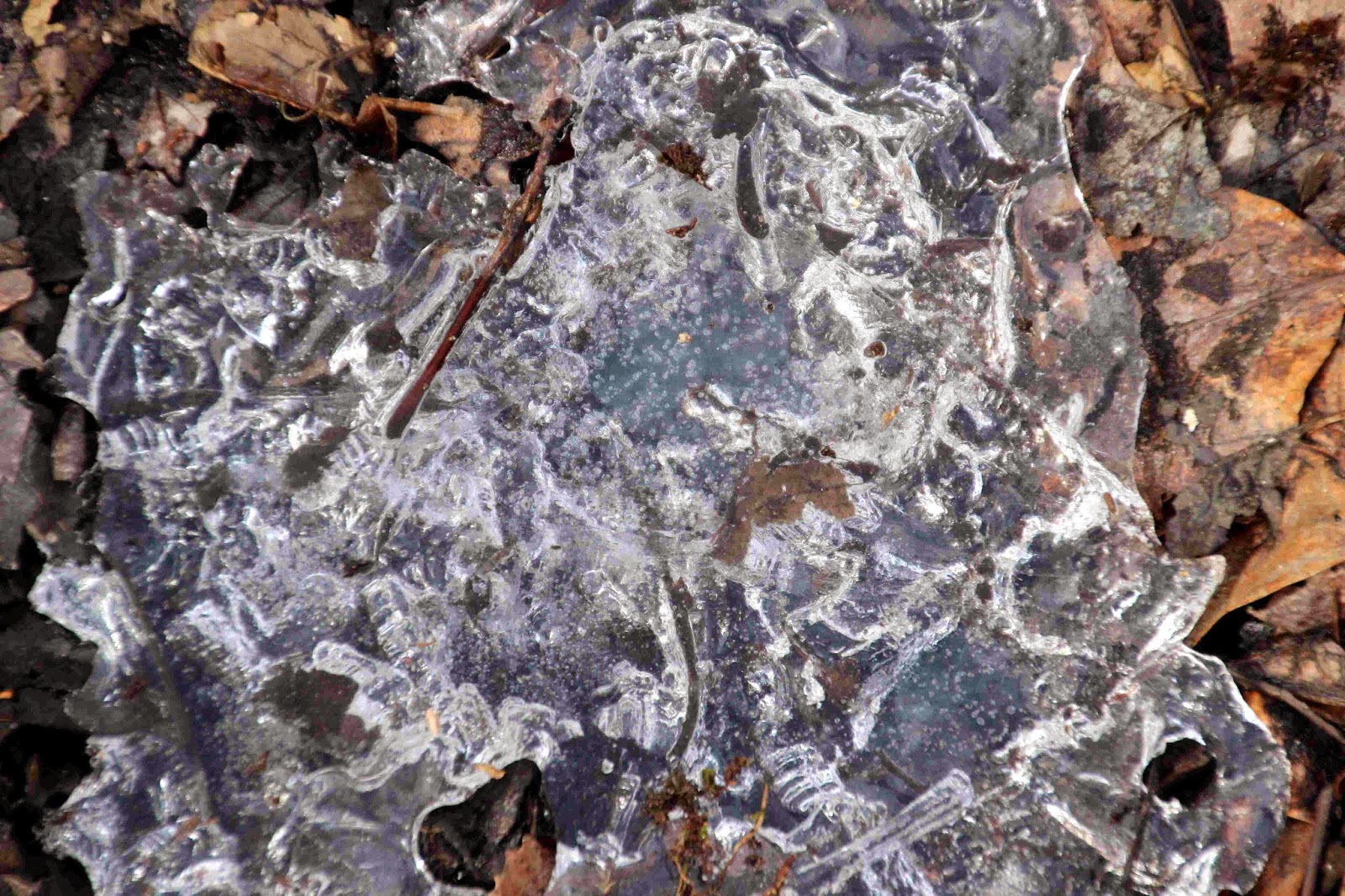
Look at patterns in the ice.

What might live in this little cave?

Visit our web site

As our website is getting updated, we have added a property list you can download. It has GPS co-ordinates for locations, links to trail maps are on the preserves page, more are coming. In the up coming months, I am hoping to work on a scavenger hunt theme for our preserves, that will do just what I described: get kids out, families together, getting them to look closely and observe and document. Right now the concept is only in my head. I will need help to formulate it and adapt it to an internet/web based activity. But in the meantime, I need to get out and do my own scavenger hunt. I will keep you all posted with my observations and hope that you will join me in a resolution to get out and get curious! Avalonia trails have a lot of treasures yet to be found. Happy New Year.
Who left shells at the base of this tree?

Who made this track?


Photographs by Beth Sullivan.

Monday, December 29, 2014

Reds and greens in the winter woods


By Beth Sullivan

We are at the darkest days of the year. The woods can look pretty drab and it even makes me wish for just a bit of snow to change the scene. But take a walk and look closely, you will find some welcome color, red and green, to greet you for the holidays.
We all know our Pines, Spruce, Firs, and Cedars, the bigger evergreens of the woodlands. They provide great protection for birds and other small creatures when the winter winds blow and snows fall. Their cones hold nutritious seeds, high in fat and protein that the wildlife need to help them through the cold season. 

Some different evergreens

Look a little lower, the shrub layer in many of our woodlands is dominated in places by our State Flower: Mountain Laurel. Drive along many of our roads where the scenery is rocky and rough, you will welcome the sight of gnarled branches and leathery green leaves of this lovely shrub. While it doesn’t provide a food supply, the usefulness as nesting sites for forest birds is often revealed in winter.
In some of the more remote wetlands areas, our native Rhododendron (R. maximum) will stand out, green against the brown. During the severe cold, you can note that the leaves droop downward and curl into tubes. This is the plants’ adaptation to protect the leaf surface from cold and dehydration in the dry winter air. 


Rhododendron leaves droop and curl in winter.

Bright winter reds

Native hollies provide winter interest. Our American holly, (Ilex opaca) the familiar Christmas decoration, has spikes on the leaves to deter deer but the berries are feasted upon by many birds, now and through the winter, as long as they last. Robins, Thrushes, and Bluebirds in particular will find a bush and claim it!
Native winter holy

Our other native holly, Winterberry (Ilex verticillata)is deciduous, but its berries glow red on bare branches during this season. These berries often do not fully ripen until they have been cold for a long time, then they ferment, and the birds love them. This is true of many berries that remain on the bush through the winter: Viburnum and crab apple in particular. Those birds know how to wait until the vintage is perfect!

Winterberry with Mantis egg case.

Mosses for the season

Club Mosses ( Lycopodium sp.) such as Princess Pine and Ground Cedar ( They have multiple common names) will populate the ground in patches. Years ago they were harvested irresponsibly for Christmas decorations and the populations were nearly decimated. Garden Clubs have protected the species by refusing to pick it, or sell decorations using the club mosses.
Ground Cedar is a clubmoss.

Emerald green cushion moss brightens the landscape.
Many other species of moss seem to become more intensely emerald at this time of year. Sphagnum moss, which holds the water in the wetlands, is more softly colored, but look closely at the structure of each plant: miniature Christmas trees!
There are a few evergreen plants, still holding leaves: Christmas Fern for one, each ‘leaflet’ on a frond has a “toe” creating a “stocking”. Partridgeberry is a sweet vining plan with delicate evergreen leaves. The occasional red berry remains on the plant as an invitation to a ‘Partridge’ who may favor the berries. Sadly our native partridge or quail, the Bobwhite is considered extirpated from Connecticut. Only to be remembered in Christmas song, being in a Pear Tree!
On the Christmas Fern, each leaflet has a stocking toe.

Partridge Berry.

Happy Holidays to all and enjoy the winter woods. 

Photographs by Beth Sullivan.