Showing posts with label American Goldfinch. Show all posts

Monday, May 4, 2020

Happy? Spring?

By Beth Sullivan
We are all painfully aware that some things are just not right. And we also have to be thinking that they may not be right, or normal, for a long time. But just for right now, let’s remind ourselves that this is truly a miraculous time of year, and some things do not change.
Maybe you have had some quiet time in the evenings to notice the chorus of our littlest frogs, the spring peepers as they wax and wane in their calling depending on the temperature. On the cold nights we have had, they hunker down underwater, in the vegetation, and stay silent. But with the rollercoaster of temperatures we have had, the very next lovely mild night, their sounds fill the wooded wetlands.
The birds have been busy and maybe you have had time to notice. Every year a pair of cardinals nests in a holly bush by the house. This year I can see the nest pretty well and hope to get some photos. Take some time to watch your yard birds and see where they go and what they are doing. I seem to have more titmice than ever before, and several of them have discovered little piles of dog fur stuck in my wood decking. They spend a lot of time picking and gathering the fur. I can spend a lot of time watching them.
Just as usual, the osprey have returned to their nest platform at Paffard Marsh. That site is noticed and photographed by so many. The Bluebirds at Knox are taking a stronger stand this year against the house sparrows, and we have several pairs nesting. We also put out the gourds for the purple martins and have had some activity, but the cold wet weather has been lethal for them.
The osprey return every year to the Paffard Marsh nest site. Photograph by Rick Newton.

Bluebirds have claimed several nest boxes at Knox Preserve. Photograph by Rick Newton.

The martins don't have to abide the rule about social distancing. Welcome mats are out.

Take a walk in the woods

A walk in the woods is completely acceptable activity. It should be mandatory. I have noticed that many of our trails are becoming very worn and hardened. Enjoy them gently and with attention. We have had Facebook comments on trailside flowers that were never noticed by people before. Right now there are many yellows: dog tooth violets or trout lilies, marsh marigolds or cowslips. Notice where the most beautiful yellow appears; it is often accompanied by some lovely purple violets. Artists know that these are complementary colors. Mother Nature is the best artist.
While we are considering yellow, have you noticed the goldfinches? People are asking: where did they come from? Where were they all winter? They were right here, often fully visible at our feeders, but only now, in the heart of spring, do the males transition to their brilliant yellow and black. Listen for their chatter in the trees. They will not be nesting for quite a while yet. They wait until mid-summer when there is an abundance of native seeds.
Trout Lily,  fleeting beauty.

Yellow marsh marigolds and purple violets. 

Male goldfinches are like rays of sunshine. Photograph by Rick Newton.

Or take a drive

I like to go out for some longer back country road drives. Looking at the changing scenery now is well worth the price of gas, especially now that it is so cheap. Head inland and uphill to get some overviews of the bigger landscape. You can still see the rocks and walls and ledges that give hard structure, bones, to the land. They are soon to be hidden by foliage, so enjoy them now. In many areas, usually wetlands, the red maples are still showing their red flowers, tinting the woodlands with misty rose color. Elsewhere Norway maples, while not native, are abundant, and their lime green-yellow flowers are truly outstanding when seen across a span. Over the last weeks there have been subtle changes in the succession of flowering trees. There were willows and the maples, now delicate shadbushes , several types of wild cherries or choke cherries. There are fruiting trees like crabapple and pear trees that have escaped cultivation and dot the wild landscape. Of course while driving around, you can enjoy everyone’s home landscaping and flowering shrubs. With the quince in full bloom, the hummingbirds should be arriving any day.
Normalcy is earlier sunrises and later sunsets. That means more daylight hours to get out and enjoy. So many things are not dependent on human presence, or absence, for so much of nature is on its own schedule, slow and steady. Take some time to savor that pace. It’s spring.
Flowering trees dot the landscape.

The hummingbirds are running a little late this year.


Photographs by Beth Sullivan unless otherwise indicated.

Monday, March 21, 2016

There's something about yellow

By Beth Sullivan

(This week's post was originally posted on April 18, 2013. We thought you might like to see it if you weren't follow this blog back then.)


Did you ever notice that it never quite feels like spring, until our world is dotted with yellow? In our yards we eagerly await the early daffodils and forsythia sprays. We don’t look forward to dandelions quite as much, but you have to admit their bright sunny yellow is a sign that spring really has arrived.
Bird lovers also await an early yellow: The American Goldfinch. This is not a true first of spring like returning migrants. Goldfinches remain here all winter, coming to our bird feeders. Through the fall and winter they are a soft, almost drab, olive color with dark wings and light white or cream wing bars. However, right about now, all of a sudden we spy a flash of bright yellow! The males have attained their breeding plumage, and are ready to show it off!

Photo by Rick Newton

Many birds change plumage when breeding season approaches. Warblers are notably confusing to birders as they change back and forth over the year. However, most of our local resident birds keep the same plumage year round. Think of Chickadees, Titmice, Nuthatches, Downy Woodpeckers, House Finches, and Blue Jays that visit our feeders through all seasons. Even Cardinals; while males and females are significantly different from one another, each remains pretty much the same throughout the year. It is our Goldfinch that changes the most dramatically.
In the fall, the males begin to get mottled looking, their feathers seem to look a little raggedy as the duller color replaces their bright yellow. During the winter the males and females look pretty much the same except for some subtle differences. Many people believe their “Wild Canaries”, their Goldfinches, have left with the other migrants. Not so.
It is curious that we don’t really notice the males changing back to yellow. Do they hide? Are they embarrassed by their disheveled appearance? No, not at all, though you have to keep your eyes open. It is just that when the day comes, and they appear at our feeder in that glorious bright spring yellow, accented by black wings and black cap; it is a stunning sight. It is hard to believe they have been here all along. A sight for sore eyes that have been counting signs of spring!
Photo by Rick Newton

Goldfinches are birds that use many habitats. They can be most frequently found in field and shrub habitats, as well as around our back yards. They are a species very dependent on seeds so in all seasons you can look for them in weedy grassy fields and hedgerows. Check the fields at the Knox Preserve, among other Avalonia properties, for the bright yellow finch perched atop a grass seed head or flower stem. They are one of the latest of the bird species to nest in the summer. They look for the downy seeds of milkweed, thistle and others to line their nests, and their young hatch when seeds are most abundant in later August.


Learn more about the American Goldfinch at the Cornell Lab of Ornithology. 

Monday, April 21, 2014

Finally-Spring at last!

By Beth Sullivan
Really what a joy it is to be able to finally see the changes happening. We all waited so long! As winter seems to have truly lost its strangle hold on everything, we can now begin to stretch a bit, get out and look around and checklist our “firsts” again.
We noted the first osprey a few weeks back, and by now most of the platforms have been staked out, claimed and the birds paired up. There is a lot of wheeling and screaming happening, and sometimes drama as the birds seem to be jockeying for position or partners. Avalonia properties offer many opportunities to observe osprey behavior. You can station yourself safely off the road on Mystic’s River Road by the Downes Marsh. The pair on Paffard Marsh on Rt 1 in Stonington is easily viewed from an adjacent parking area if there are no events at the venue. My favorite place to spy on the osprey is from the trail on Knox Preserve. You can either sit high on the rocky knoll and be almost at nest level, or be closer, almost under the nest, on the lower trail. It is mesmerizing.

Osprey are now paired at their chosen nest sites.


It is also time to welcome other new arrivals. While a few individuals of a species, such as Catbird or Mockingbird, may have hunkered down for the winter here, most are beginning to arrive from their winter homes and make themselves known with their recognizable calls as they take up residence in tangles of shrubs. A Catbird can be quite noisy under an open window at dawn’s first light!
Some Catbirds remain all winter, but most are returning from southern climates.

Mockingbirds may sing at night as they take up residence in a favorite shrub.

People often say “the Goldfinches are back” but in reality they have been here all along, in subtle dull plumage suitable for winter. It is only now that the males are molting their drab colors and showing up fresh and bright yellow with black cap and wings. He looks all -together different, but has been at our feeders, moving about the area, throughout the winter. Dandelions, Forsythia, Daffodils and Goldfinches, all herald spring with yellow.
The male Goldfinch now displays spring yellow!

We will start to miss our Juncos, one day here and the next they are quietly gone. White Throated Sparrows remain until well into May and in the morning and evening can be heard whistling their full spring songs.
Juncos will remain as close as northern New England for nesting season.
White-Throated Sparrows will stay here until May.

They too seem to slip away while we are paying attention to all the new arrivals of Warblers and others that will stream in during the next weeks.
Yellow Warblers will be arriving on warm spring breezes.

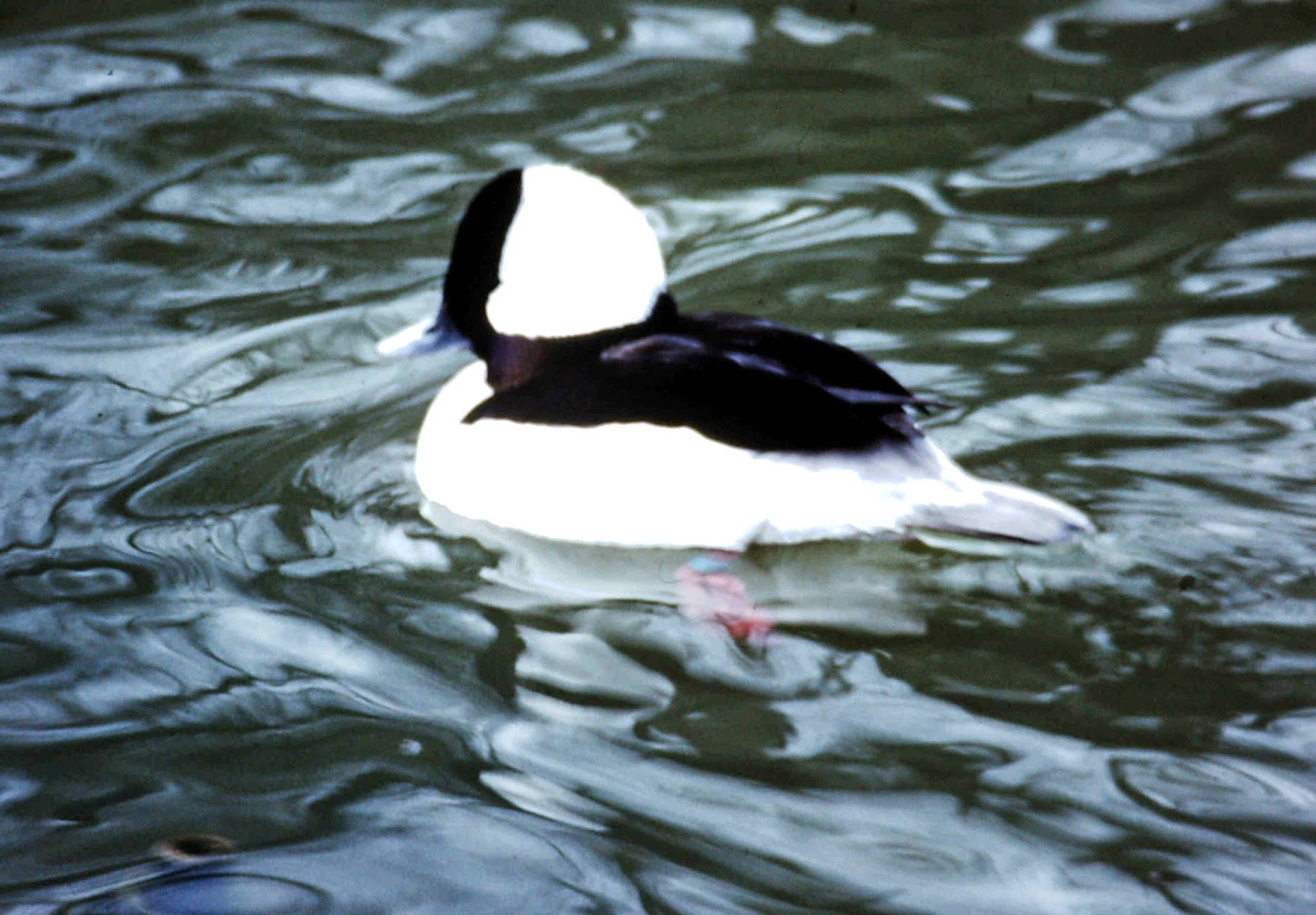
You may also one day notice that there are fewer ducks: no Buffleheads and Hooded Mergansers on our coves. Some of our winter ducks fly to the far North and Northwest to arctic breeding grounds. Instead we can be entertained by the antics of male Mallards strutting and showing off glossy green heads, as they try to out-do one another to entice the females. Soon they will be nesting.
Buffleheads are returning to their far northern breeding grounds.

Hooded Mergansers have left already. 
Male Mallards will be competing for their mates.
Such an active time now: take time to observe. Find a spot and watch spring stream in, right before our eyes, on the wings of the birds.

Photographs by Rick Newton and Beth Sullivan.

Thursday, April 18, 2013

There is something about yellow…….


Did you ever notice that it never quite feels like spring, until our world is dotted with yellow? In our yards we eagerly await the early daffodils and forsythia sprays. We don’t look forward to dandelions quite as much, but you have to admit their bright sunny yellow is a sign that spring really has arrived.
Bird lovers also await an early yellow: The American Goldfinch. This is not a true first of spring like returning migrants. Goldfinches remain here all winter, coming to our bird feeders. Through the fall and winter they are a soft, almost drab, olive color with dark wings and light white or cream wing bars. However, right about now, all of a sudden we spy a flash of bright yellow! The males have attained their breeding plumage, and are ready to show it off!

Photo by Rick Newton

Many birds change plumage when breeding season approaches. Warblers are notably confusing to birders as they change back and forth over the year. However, most of our local resident birds keep the same plumage year round. Think of Chickadees, Titmice, Nuthatches, Downy Woodpeckers, House Finches, and Blue Jays that visit our feeders through all seasons. Even Cardinals; while males and females are significantly different from one another, each remains pretty much the same throughout the year. It is our Goldfinch that changes the most dramatically.
In the fall, the males begin to get mottled looking, their feathers seem to look a little raggedy as the duller color replaces their bright yellow. During the winter the males and females look pretty much the same except for some subtle differences. Many people believe their “Wild Canaries”, their Goldfinches, have left with the other migrants. Not so.
It is curious that we don’t really notice the males changing back to yellow. Do they hide? Are they embarrassed by their disheveled appearance? No, not at all, though you have to keep your eyes open. It is just that when the day comes, and they appear at our feeder in that glorious bright spring yellow, accented by black wings and black cap; it is a stunning sight. It is hard to believe they have been here all along. A sight for sore eyes that have been counting signs of spring!
Photo by Rick Newton

Goldfinches are birds that use many habitats. They can be most frequently found in field and shrub habitats, as well as around our back yards. They are a species very dependent on seeds so in all seasons you can look for them in weedy grassy fields and hedgerows. Check the fields at the Knox Preserve , among other Avalonia properties, for the bright yellow finch perched atop a grass seed head or flower stem. They are one of the latest of the bird species to nest in the summer. They look for the downy seeds of milkweed, thistle and others to line their nests, and their young hatch when seeds are most abundant in later August.
Written by Beth Sullivan.

Learn more about the American Goldfinch at the Cornell Lab of Ornithology.