Showing posts with label spring firsts. Show all posts

Monday, April 15, 2019

Spring Cleaning can be a pleasure

By Beth Sullivan
We all hope that we have truly seen the last of the snow. The weather remains fickle, but it doesn’t stop us from getting out and ramping up stewardship efforts. It is a good time of year to work outside. It is a time to notice things. Whether you are hiking or doing yard work or helping with a stewardship project, the tasks are always more enjoyable because of the new sights and sounds that pop up around us every day now. As you get out to hike on the preserves, enjoy these wonderful sensory treats.
A red winged blackbird stakes a claim at Paffard Marsh. Photograph by Dan Hall.

Ticking off my firsts

Red-winged blackbirds are fully vocal now and setting up territories near wetlands. They also will show up at birdfeeders and if you watch them, you will witness the flaring of their red shoulder patches when confronted by rival males, or an attractive female.
The nights are still filled with the chorus of peepers but the wood frogs are slowing down. Mission accomplished.
The Phoebes are looking for nest sites and calling their name. There are plenty of flying insects around now to sustain them, at least as long as the weather stays warm enough for insects.
In just the last days, I have reports of the first purple martins showing up at local colonies where the housing has been set up in peoples’ home yards. Because ours is out on Knox Preserve, and I can’t keep a close eye on it every day, I will hold off setting it up for a while to wait for a bigger wave of martins as they arrive and hope to dissuade the invasive house sparrows. The next month will bring the flood of migrants here for nesting or resting on their way further north.
Some of the spring ephemeral wildflowers are blooming, if you know where to look. Please do not pick them.
The warmer weather has also brought out ticks. After the wet winter and spring, we are being told to beware. Please take precautions while you are out in the woods and grassy areas.
The spring woodlands are still open and becoming delicately colored now.

To protect ground-nesting birds and small mammals, please refrain from walking into fields.

Some things to think about

As we get into late April, many species of birds and mammals will begin nesting in fields and shrubs. It will be time to exert good judgment and to refrain from walking through our field preserves. Please use only the trails that allow easier and better travel - better for you and for wildlife. This is especially the time to keep dogs on leash and under control. Loose dogs will frighten, threaten, and even kill vulnerable young animals and birds. They can cause adults to abandon their young or nest. Loose dogs in vernal ponds and in streams can destroy egg masses of Amphibians.
We have also our stewardship efforts: maintenance, clean up on trails, and walks to check for winter damage. If you spot a problem, please call the office. If you can help with a work party or want to work on your own, contact the office or sign up on line. You will be directed to a steward in your town or the trails team leader for advice and guidance. There are other things to be done as well, for example, our many signs can be freshened up with new coats of paint. If you have time, grab a garbage bag, don some gloves, and pick up some roadside eyesores to help anywhere you can.
Every little bit helps, whether it is an active act of stewardship or just walking the preserves with an open eye and understanding why they are preserves.
Enjoy the coming spring!
Loose dogs can disturb nesting creatures in brush piles, fields, and vernal pools.

Well camouflaged, the wood frog in this vernal pool was one of many chorusing earlier this spring.

Roadside litter along our preserve frontages is a never-ending issue.


Photographs by Beth Sullivan, unless otherwise indicated.

Monday, April 8, 2019

Spring is for children of all ages

By Beth Sullivan
We all have different ways of recognizing spring. Some look at the date on the calendar, but many of us have our own personal spring triggers. We wait for the sound of peepers or wood frogs; we wait until we feel the warmth of the sun. We enjoy the longer days and time to enjoy sunlight at the end of the workday. We wait for the red blossoms on the swamp maples, the first pussy-willows or snowdrops. We look for the first robin or osprey or phoebe. We wait to lose the heavy coats and restrictive layers.
Exploring at night is all the more exciting. Photograph by Bruce Fellman.

Let her have an independent venture into the water.

Go outside

But the general theme here is that we are all just bursting to get outside! Lose the coats, get rid of snow boots but dress for mud and fickle weather. The only way to find those flowers or birds and hear those frogs is to GET OUT!
We all know that we just feel so much better when we can get the sun on our faces, stretch the muscles and reacquaint ourselves with the sights and sounds of the Earth. We feel rejuvenated, energized and truly happier. But did you know that there are a number of actual academic studies that have been published that prove these “gut feelings” are actual scientifically-based effects of the exposure to nature.
There are objectively measured effects from the better quality air outdoors, compared to the sealed up classrooms and homes of winter. Too much carbon dioxide can make you sleepy and even stunt mental functions. You can read about it here.  Open a window, or better still, get outside where the air is cleaner and more oxygenated and you immediately feel better. Sadly though, there are those with seasonal allergies and this may not always hold true for you.
Then there is sunlight itself, essential for life, photosynthesis, respiration and warmth. Sunlight is the best way for our bodies to create Vitamin D which is essential for the health of our bones. It is a known mood lifter, bio-rhythm regulator, and even if you just sit still in a warm sunny spot outside, you are benefiting. But who sits still when there are all the new spring things to explore? So now we add exercise and cardio into the outdoor equation.
Those of us who were lucky to have had early exposure to open space, water and dirt had the best education of all. We learned so much from our experiences outdoors. We were usually happier outside than in. We ran, we hid, we dammed up little brooks and caught frogs. We learned botany, biology, math and physics. We were content and usually that translated into better appetites, better focus on studies, better sleep at night.
It's never too early to start exploring.

Poking into a pool can be a bit daunting. Using a stick is okay. Photograph by Bruce Fellman.

Even alone, go outside

Interestingly, not all outside play has to be social. Some of the very best lessons can be learned alone. Learning about yourself and your place in the world, and how to be happy without a big group of friends and gadgets, is probably the best life lesson of all.
You don’t need all the scientific data to make you know how wonderful it is to be outside now. But there's one more study here.
As “my generation” grows up a bit, it is time to make sure the next generations have the same opportunities to learn and explore and be healthy and happy. We may be blessed to even influence the next generation after that. I feel we owe it to them to try and give them the best of our world even when, sadly, we are leaving it dirtier and more broken than when we were kids.
Most of us have children in our lives in some connection. Think of what you can share with a child: your experiences and wisdom and joy in the outdoors. Teach them to listen and smell and enjoy touching even those things deemed “gross” or “dirty”. They will survive. They will thrive. They will be happier and so will you.
Being alone increases self reliance and creativity.

You can learn plenty by joining a kid on an adventure.

Photographs by Beth Sullivan, unless otherwise indicated.

Monday, March 14, 2016

Babcock Ridge revisited

By Beth Sullivan
The day was too beautiful. It begged for a special hike. Last fall we walked Babcock Ridge and got a bit turned around at a couple of places. It was a great hike but the trail was not yet ready. But the Avalonia volunteers in North Stonington have been busy all winter and it shows!
We needed to get out with GPS equipment on the trails so maps can be created and posted on the trails and on-line for visitors. The entry is a small pull-off lot at 113 Babcock Road. There is room for several cars. Once signage goes up after a formal dedication later this spring, it will be far easier to spot from the road.
The trail is blazed in blue and starts out as an easy wide trail, the “stem of the lollipop” before the loop portion begins. Through force of habit, I always go counter-clock wise, to the east first. If it makes a difference to anyone, this way has a steep upslope segment with an “easier way” alternative offered. No problem at all. The clockwise route would provide a longer but somewhat more gradual slope upward.

Mourning Cloaks announce spring

We got the GPS, smart phone and camera all ready to go, and set off. Immediately we were greeted by several Mourning Cloak butterflies. These are the first to emerge in the spring after a winter hibernation. They tend to like to overwinter in crevices and cracks in rocky areas and hollow trees. There are plenty of both at Babcock and the warm sun brought them out. We had at least a dozen on the whole hike. A perfect first sign of spring!
One of several Mourning Cloaks out and about on a warm day.

A short way farther along the trail, we could begin to hear the “quacking” sound of Wood frogs in the vernal pool. As we got closer the chorus got stronger and was joined by a few Spring Peepers. I was apparently not quiet enough in my approach, because they stopped their calling. However the water was in constant motion as I could see individuals swimming in the shallow, warmed water. They will be laying eggs soon,as will the Spotted salamanders, and the vernal pool will host larval Marbled salamanders and Fairy Shrimp, as well. If you approach, be patient, sit still, the chorus might resume for you.
The early Spring vernal pool was noisy on this sunny day.

Wetlands to see

The trail drops down to a wetland area. Here you make a choice. The blue trail goes pretty straight up the ridge. A yellow-blazed “easier way” crosses the beautiful green, mossy wetland and makes a switchback trail up to the top in a more gradual way. I would take the wetland option, just because it is pretty.
Wetlands spread out rocky and mossy.

When the trails reconnect, it continues up and up to the top of the rocky ridge. Along the way you can see large ledges, caves, and rock faces covered with lichen and fungi. You can imagine what creatures would use these caves for denning opportunities.
Wonder what might live in this cave?

At the top, elevation about 290 feet, the winter views are far and wide. A few little side trips off the trail to peek over the edge are well worth it! We encountered a garter snake sunning against a warm rock. It was not happy to be disturbed! The trail crosses through the stone wall and actually joins the southern portion of the Erisman Woodlands loop. Here you can make some more choices. You can continue on the Babcock trail and head south back down to where you began, or you can follow the Erisman loop trail, extending the hike, in essence making a figure eight. It was well signed and easy to follow. Enjoy the top. If you are lucky you might glimpse the elusive Pileated Woodpecker that resides up there.
This Garter snake was not happy we disturbed its sunbath.

The trail offers choices and is easy to follow.

This day we took the Babcock loop back down. We noted old barbed wire, signs of historic boundaries, some of which was so deeply embedded into the trees it was completely encased. The wetland is more spread out, rockier here, and the stream is fuller and babbles more.
The elusive Pileated Woodpecker. Photograph by Niall  Doherty.

Ancient barbed wire, embedded deeply, speaks of the land's history.

Looking at the landscape in winter, it is easy to imagine the path of the glaciers, leaving rocks and ledges and all sorts of rocky till, making valleys for the water to collect and flow.
The trail is a bit more than a mile and a half, easy to follow, with lots to look at. I cannot wait for the season to progress, the greenery to change the views. Maybe next time I will go clockwise!
There is a special dedication of this Preserve, tentatively scheduled for May 14th. Please check the website for details.


Photographs by Beth Sullivan, unless otherwise indicated.

Monday, April 13, 2015

Checking off Spring things

By Beth Sullivan
Finally, I think we can believe that the back of winter is broken, and that we are on the way to spring. In just the last week or two, some of the things I have been waiting for have made an appearance:
Red-Winged Blackbirds singing their spring song and declaring territory and more and more Osprey establishing themselves on nesting platforms.
The local Phoebe has begun to call, though still not frequently.
The Tree Swallows at Knox Preserve have begun swooping over the fields and checking out nest boxes.
The Spring Peepers are really cranking up the volume on the warmer nights from vernal pools around town. I am amazed they can sing even on the most recent chilly nights.
The greening still seems delayed. Buds are only just swelling, and the Hellebores in the wet woods have not shown themselves yet.

A Red Winged Blackbird stakes a claim at Paffard Marsh. Photo by Dan Hall.

Osprey arrived at Knox nest site.

This Green Frog just emerged from hibernation. Wood Frogs and Peepers have been out for two weeks and already are chorusing.

It will be time to start some clean-up work out on the preserves. Winter snowbanks covered a lot of trash along North Main Street. I am so disappointed in those humans who don’t seem to think or care when they toss their garbage! We may have a group of young “Explorers” willing to help along Fennerswood Preserve. If you see them out there, give a wave and a thumbs up. Work will resume on repair and rebuilding of the walls along North Main Street as well. They look nice already with the snow gone and brush all cut back.
Work will resume on stone walls. Some signs need repainting.

Get to the Great Outdoors

As you get out to hike on the preserves, enjoy the sights and sounds. The next month will bring the flood of migrants here for nesting or resting on their way further north.
The warmer weather has also brought out ticks. After the wet winter and spring, we are being told to beware! Please take precautions while you are out in the woods and grassy areas.
A few things to think about please: as we get into later April, many species of birds and mammals will begin nesting in fields and shrubs. It will be time to exert good judgment and to refrain from walking through our field preserves. Please use only the trails that allow easier and better travel-better for you and for wildlife. Especially, please, this is the time to keep dogs on leash and under control. Loose dogs will frighten, threaten, and even kill vulnerable young animals and birds. They can cause adults to abandon their young or nest. Loose dogs in vernal ponds and in streams can destroy egg masses of Amphibians.
Loose dogs can disturb nesting creatures in brush piles, fields, and vernal pools.

Vernal pools shelter amphibians and egg masses at this time of year.

To protect ground nesting birds and small mammals please refrain from walking into fields.

Stewardship in high gear

We will also begin our stewardship efforts: maintenance, clean up on trails and, walks to check for winter damage. If you spot a problem, please call the office. If you can help with a work party or want to work on your own, contact the office, and you will be directed to a steward in your town for advice and guidance. There are other things to be done as well; our many signs can be freshened up with new coats of paint. If you have time, grab a garbage bag, don some gloves and pick up some roadside eyesores to help any-where you can.
Migrating Ring-necked Ducks stop on sheltered waterways on their way north.

Every little bit helps, whether it is an active act of stewardship or just walking the preserves with an open eye and understanding why they are “Preserves.”
Enjoy the coming spring!

Photographs by Beth Sullivan, unless otherwise indicated.

Monday, April 21, 2014

Finally-Spring at last!

By Beth Sullivan
Really what a joy it is to be able to finally see the changes happening. We all waited so long! As winter seems to have truly lost its strangle hold on everything, we can now begin to stretch a bit, get out and look around and checklist our “firsts” again.
We noted the first osprey a few weeks back, and by now most of the platforms have been staked out, claimed and the birds paired up. There is a lot of wheeling and screaming happening, and sometimes drama as the birds seem to be jockeying for position or partners. Avalonia properties offer many opportunities to observe osprey behavior. You can station yourself safely off the road on Mystic’s River Road by the Downes Marsh. The pair on Paffard Marsh on Rt 1 in Stonington is easily viewed from an adjacent parking area if there are no events at the venue. My favorite place to spy on the osprey is from the trail on Knox Preserve. You can either sit high on the rocky knoll and be almost at nest level, or be closer, almost under the nest, on the lower trail. It is mesmerizing.

Osprey are now paired at their chosen nest sites.


It is also time to welcome other new arrivals. While a few individuals of a species, such as Catbird or Mockingbird, may have hunkered down for the winter here, most are beginning to arrive from their winter homes and make themselves known with their recognizable calls as they take up residence in tangles of shrubs. A Catbird can be quite noisy under an open window at dawn’s first light!
Some Catbirds remain all winter, but most are returning from southern climates.

Mockingbirds may sing at night as they take up residence in a favorite shrub.

People often say “the Goldfinches are back” but in reality they have been here all along, in subtle dull plumage suitable for winter. It is only now that the males are molting their drab colors and showing up fresh and bright yellow with black cap and wings. He looks all -together different, but has been at our feeders, moving about the area, throughout the winter. Dandelions, Forsythia, Daffodils and Goldfinches, all herald spring with yellow.
The male Goldfinch now displays spring yellow!

We will start to miss our Juncos, one day here and the next they are quietly gone. White Throated Sparrows remain until well into May and in the morning and evening can be heard whistling their full spring songs.
Juncos will remain as close as northern New England for nesting season.
White-Throated Sparrows will stay here until May.

They too seem to slip away while we are paying attention to all the new arrivals of Warblers and others that will stream in during the next weeks.
Yellow Warblers will be arriving on warm spring breezes.

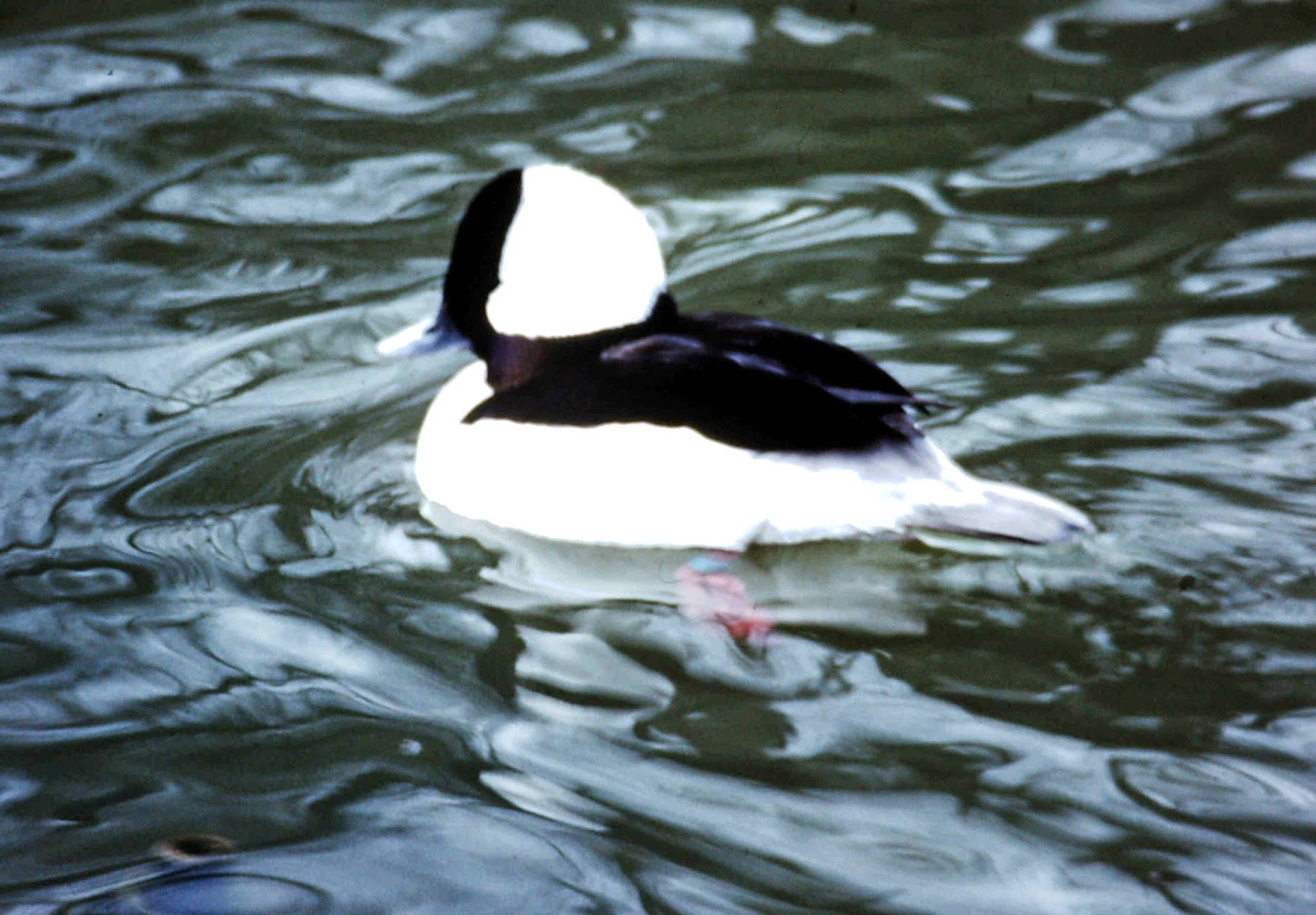
You may also one day notice that there are fewer ducks: no Buffleheads and Hooded Mergansers on our coves. Some of our winter ducks fly to the far North and Northwest to arctic breeding grounds. Instead we can be entertained by the antics of male Mallards strutting and showing off glossy green heads, as they try to out-do one another to entice the females. Soon they will be nesting.
Buffleheads are returning to their far northern breeding grounds.

Hooded Mergansers have left already. 
Male Mallards will be competing for their mates.
Such an active time now: take time to observe. Find a spot and watch spring stream in, right before our eyes, on the wings of the birds.

Photographs by Rick Newton and Beth Sullivan.

Monday, March 24, 2014

Spring cleaning and other signs

By Beth Sullivan
Winter has officially ended, and as this is written the meteorologists are getting all excited about yet another “Snow Bomb”. However, it is more important to review the last week of good days and recognize that things are indeed changing around us.
Because the weather has been so nice for the last several days, we have been out beginning our spring cleaning on several preserves. It has been great to be out and working again and, while doing so, it is impossible to not notice those spring signs. Last year at this time, I dedicated several blogs to spring firsts: Osprey,  Skunk Cabbage, among others. Go back and review…we may need reminders this year since so much is late! However, the first osprey for me arrived today on the nest at Paffard Marsh Preserve on Route 1 in Stonington. Another was reported on the Downes Marsh on River Road in Mystic. I have only heard one Phoebe. As insect eaters, I surely hope they remain down south until the next blast of weather is done. A quick stroll around Paffard Woods and Knox Family Farm revealed Skunk cabbage populating the wetlands there.
The Osprey returned to Paffard Marsh this week.

Skunk cabbage start growing with snow all around.

There have been a few reports of amphibians also. The couple of warmer days melted the vernal pools and softened the earth so a little stirring began: a few tentative peeps from the Spring Peepers, one very cold Wood frog uncovered by an excited child in the woods, and a few brave Spotted Salamanders moving into breeding pools. All of these will need to seek shelter when the temperatures return to frigid or their lives will be in jeopardy.
A Spotted Salamander in its wetland habitat. 

The cold did not stop us from getting a lot done this week. Our collaboration with the Goodwin Niering Center for the Environment, at Connecticut College, provided us with willing hands: 50 students=100 hands! Their team leader will be guest writing this blog over the next weeks about their effort, so I will not go into details. All I can say is WOW! Please find some time to take a walk at Dodge Paddock in the Borough and notice the changes. Drive along North Main Street and the Paffard Woods Preserve and admire the gorgeous stone walls!
Students from Connecticut College work on clearing the stone walls at the edge of Dodge Paddock in Stonington Borough.

And while you are out, please notice that the fields at the Knox Preserve have been mowed, thanks to some wonderful volunteers with time, energy and the right machines! They uncovered mice and vole tunnels as well as discovering woodchuck burrows. The shortened grass will encourage the Woodcocks as they seek out the wet areas, and sparrows are enjoying gleaning the seeds now on the ground. Red-winged Blackbirds are singing at the little pond.


Red winged Black Bird.
Newly mowed Knox Preserve waiting for warmer temperatures.

I guess spring has arrived! Enjoy it.

Photographs by Beth Sullivan, Rick Newton, and Roger Wolfe.

Thursday, March 28, 2013

Another First - The Osprey


Spring struggles to arrive. Winter has done its best to thwart us: snow, cold, wet, dark and gray. Yet spring does arrive; birds return; amphibians emerge; plants begin to break ground and their buds swell.
Many spring events are triggered by daylight and day length; others respond to warmth. Some need both. Avalonia volunteers spend a lot of time outdoors, all year long, and we respond to day light and warmth too. As we are out and about, we are looking for signs of spring and continue to count “FIRSTS”.

                                                        Photo by Rick Newton


Birds that have spent the winter in southern climates don’t know what the weather is like up here, so they rely on day length to trigger their impulse to return north. Of course, a nice southerly breeze is a big help and frequently in mid to late March we experience a period of warm teasing weather. It is during these times we look for our returning birds, and the most eagerly awaited are the osprey. Many of the osprey from our area winter in Central and South America. As the hours of daylight begin to increase and reach equality with hours of dark at the Spring Equinox, these birds are making their return. Here in Southeastern CT we count on them arriving around St Patrick’s Day, give or take a few days. Ospreys are very loyal to their nest sites. While males and females do not spend the winter together, banding records and studies have shown that bonded pairs will return to the same nest site, usually at different times, and one will wait for the other to renew that bond for another year.
Despite the strangle-hold of winter, the first osprey was reported locally on Saturday March 16th. Right on time. As “fish hawks” they rely on open water to find food. While the ice has melted from most bodies of water, fish often tend to swim deeper to find warmer temperatures. If the weather continues cold with freezing nights, the newly arrived osprey may have a hard time finding food. However, as the next weeks go by, temperatures are bound to warm up. With southerly breezes, more osprey will return to their nest sites along the shore, and there will be plenty of food.

                                                        Photo by Rick Newton

Take some time to look for the very visible platforms used for nesting. Decades ago, osprey nested on big dead trees, called snags, along marsh edges, and along the shore. Those sites have nearly disappeared and now osprey rely almost exclusively on man-made platforms for nesting. They will reuse and enhance and enlarge the nest each year, some reaching quite impressive sizes. After the super storm Sandy last fall, and the blizzard and wind storms this winter, the returning osprey may have more work to do.

Now that the weather is finally warming, go find a nest site, and observe from a distance. Several Avalonia properties in Stonington have osprey nests, including Cottrell Marsh, Continental Marsh, and Paffard Marsh which may have the most visible one. There is also one just over the railroad tracks very visible from the Knox preserve. Many others are on private or state properties all along the shore. Enjoy the return of the osprey!

Written by Beth Sullivan

Learn more about the osprey at the Cornell Lab of Ornithology